For those unfamiliar, this syndrome involves the absence of sternal head of the pectoralis major, hypoplasia and/or aplasia of breast or nipple, deficiency of subcutaneous fat and axillary hair, abnormalities of rib cage, and upper extremity anomalies. The upper extremity anomalies include short upper arm, forearm, or fingers (brachysymphalangism). Remarkably, I had never seen one of these cases in my clinic before, but met a nice gentleman recently who thought his syndrome was called "Pol's Syndrome, or something like that," and with the quick help of Google, he and I quickly surfed the web together in my office and discovered he actually had "Poland's Syndrome."
I was referred to see him for non-sustained asymptomatic ventricular tachycardia noted on a recent stress test. Consequently, an EKG was performed. Before I get to that, my patient was nice enough to permit me to include the photos of his chest and upper extremities and share them here:
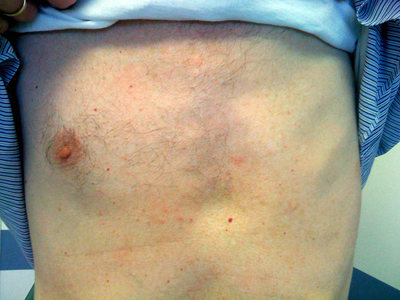
The Chest of a Patient With Poland's Syndrome
Note the congenital abscence of the left nipple and pectoralis muscle.
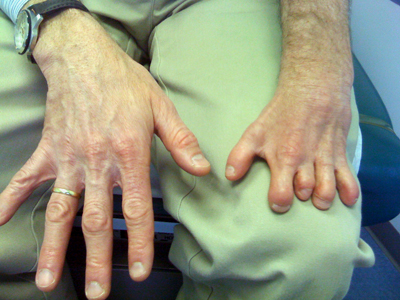
Hands of a Patient With Poland's Syndrome
The left hand has gone under significant reconstruction to permit an opposable thumb and individual digits.
So now, in the spirit of collegiality in medicine, I'd like to add one more thing to the syndrome: possible "pseudo-ventricular hypertrophy on the EKG when the left pectoral muscle is absent." Here's the patient's EKG:
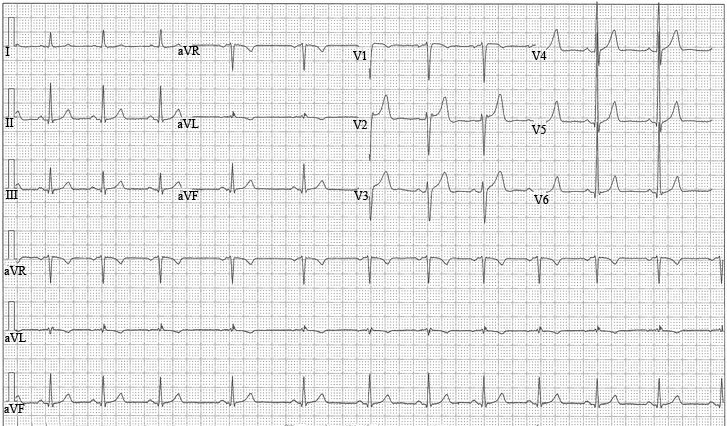
EKG of a Patient With Poland's Syndrome - Click to Enlarge
Note the present of large precordial voltage suggestive of left ventricular hypertrophy due to proximity of the EKG leads to the heart.
There. This modification to the syndrome is now etched in the highly scientific ether of the blog-o-sphere. Of note, his echocardiogram failed to demonstrate any left ventricular hypertrophy or cardiac anomaly.
-Wes

