I look forward to teaching our housestaff the basics of EKGs each year. Moments where I can leap from worker-bee clinician to the quiet confines of a lecture hall is rejuvenating. Seeing eyes widen as they grasp basic insights to the wealth of information contained in biologic signals even more so. So I carve some time at the beginning of each year with the chief residents to commit to this endeavor far in advance.
This year, I arrived a little early for my lecture with a stack of EKG’s, ready to bring down the screen, load the Powerpoint presentation, and collect my thoughts. Unlike most lecture days, the lecture hall door was closed when I arrived. I quietly cracked the door and peered in: there, in their new, carefully pressed white coats, was a sea of residents. I was elated, expecting that attendance at this lecture would be especially high since I already had a captive audience.
So I closed the door quietly and paced in the halls waiting for the lecture before mine to conclude.
The nearby secretaries noticed me and politely said hello and I, in turn, smiled and acknowledged their greeting. I grabbed a quick cup of coffee from the coffee pot and sipped the nectar in my quiet moment of reverie before class.
But something was askew. The secretaries seemed a bit uncomfortable.
“Doctor Fisher? Oh, I’m so sorry, the lecture hall is being used today for our annual Transitional Residency program review. Let me see if I can find another lecture hall for you.”
She logged on her computer and scanned the available spaces. She clicked and clicked and clicked.
“Well, there is a room on the fifth floor…. Um, maybe not. I see there’s only 15 chairs in there… Let me keep trying.”
“Thanks so much,” I said.
About this time, the doors from my previously-arranged lecture hall opened and a sea of smiling residents poured out from the room. Some headed to the washroom, others checking their beepers. Others appeared to be heading back to the wards. I was puzzled.
I glanced in the lecture hall to see several well-dressed women sitting before a pile of 3-ring binders full of papers, one of which was opened. They chatted with each other, occasionally giggling, but very professionally so. There behind them was a tray of uneaten donuts and other treats and a coffee dispenser neatly arranged on a tray behind them. Boy, those looked tasty! I smiled as I thought to myself: “No wonder their attendance was so good.”
A few moments later, one of the Chief Residents came to me with his tail between his legs and apologized profusely. “I’m SO sorry, Dr. Fisher, we forgot to call you about this change of schedule!”
The poor guy. Sent with full flak jacket in place to take the hit. But I knew exactly how he felt as he tried to keep all the various clinical and administrative scheduling balls in the air.
“No problem,” I said. “We’ll do this another time.”
But as I walked back to my office, I couldn’t help but wonder what we’re creating as housestaff are corralled before bureaucrats who ask them how their residency is going while their own residency's EKG training was silently sabotaged.
It’s kind of like those uneaten donuts behind those well-dressed ladies: food for thought.
-Wes
Wednesday, September 12, 2012


Tuesday, September 11, 2012
Why Patients Will Need Influence Peddlers
"Hello, Dr. Fisher this Dr. Schmo. I have a special (friend, patient, secretary - insert your title here) that I'd like to see you but your next new patient appointment is in about 2-3 months. Could you see him/her sooner?"
It's a call that's becoming increasingly common.
In the past, this was a request that was fairly easy to fulfill for a friend. But this week this has already happened three times. I wonder (a) how many times I can realistically expand my clinic hours and (b) how many follow-up patients I'll soon stop seeing to make room for the masses as pressure to see more people in less time continues and (c) how many patients will use this approach to leverage access to health care?
The days of long-term relationships between patients and subspecialists seem to rapidly be coming to an end - our new model increasingly rewards proceduralists.
But such an approach is not without its consequences. Doctors and patients both lose when we lose closure with our patients.
-Wes
Monday, September 10, 2012
The Empty Chairs
It's the skit I would have liked to see by either political party:
Eastwood: "So, would each of you like to introduce yourself to the American Public?"
* silence *
Eastwood: "How many of you are licensed physicians?"
A few raise their hands.
Eastwood: "Really, that's all? (Mumbles under his breath, "Wow." He continues: "How many of you are men and how many are women?"
* silence *
Eastwood: "Given there are 50 states in the United States, could you tell us in which state each one of you live?"
* silence * As if no one wants to admit where they live...
Eastwood: " If one of you gets sick, are there only 14 people who vote or does someone else gets picked?"
* silence *
Eastwood: "How many of you have parents still living over 75?"
A few hands are raised.
Eastwood: "How many of you are less than 35 years of age?"
* silence *
Eastwood: "How many of you have ever told someone they have cancer and then cared for them?"
* silence *
Eastwood: "How many of you received grants of any kind from the US government? Any of you stand to receive benefits from the US government of any kind? Might one of those benefits include health care for you or your family?"
* silence *
Eastwood: "Do any of you carry the BRCA1 or BRCA2 gene for breast cancer or does anyone in your family?"
* silence * Some appear confused by the question.
Eastwood: "Would each of you share your religious affiliation with America? Any atheists amongst you?"
* silence *
Eastwood: "Well, it seems we're not getting too far. I guess we'll conclude there and ask the American people what they'd like to ask you..."
* Opens microphone to responsible voices... *
-Wes
 |
| The Independent Payment Advisory Board |
Eastwood: "So, would each of you like to introduce yourself to the American Public?"
* silence *
Eastwood: "How many of you are licensed physicians?"
A few raise their hands.
Eastwood: "Really, that's all? (Mumbles under his breath, "Wow." He continues: "How many of you are men and how many are women?"
* silence *
Eastwood: "Given there are 50 states in the United States, could you tell us in which state each one of you live?"
* silence * As if no one wants to admit where they live...
Eastwood: " If one of you gets sick, are there only 14 people who vote or does someone else gets picked?"
* silence *
Eastwood: "How many of you have parents still living over 75?"
A few hands are raised.
Eastwood: "How many of you are less than 35 years of age?"
* silence *
Eastwood: "How many of you have ever told someone they have cancer and then cared for them?"
* silence *
Eastwood: "How many of you received grants of any kind from the US government? Any of you stand to receive benefits from the US government of any kind? Might one of those benefits include health care for you or your family?"
* silence *
Eastwood: "Do any of you carry the BRCA1 or BRCA2 gene for breast cancer or does anyone in your family?"
* silence * Some appear confused by the question.
Eastwood: "Would each of you share your religious affiliation with America? Any atheists amongst you?"
* silence *
Eastwood: "Well, it seems we're not getting too far. I guess we'll conclude there and ask the American people what they'd like to ask you..."
* Opens microphone to responsible voices... *
-Wes
Saturday, September 08, 2012
EKG Du Jour #27: Caught in the Act
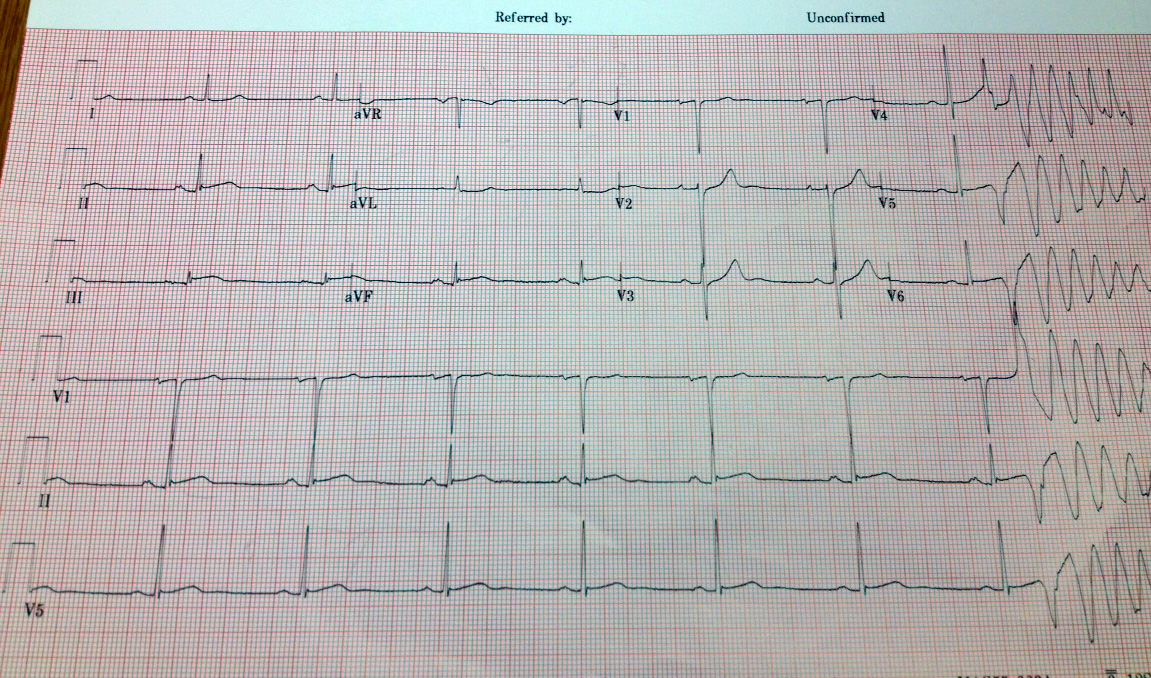
I've been looking at EKG's for over 20 years and I'm not sure I've ever seen this captured on a 12-lead electrocardiogam outside the EP laboratory.
The patient was admitted with some vague chest discomfort. The initial EKG and troponins were normal, but they decided to admit the patient anyway for observation. Once on the ward after being given some heparin and aspirin, the patient was feeling perfectly fine - wanted to go home - but the second set of troponins returned positive. The first year resident decided to order a second EKG.
The EKG technician came dutifully, performed the EKG, and before she knew it, all hell broke loose:
Fortunately, the patient did well after a quite bit of work in the cath lab.
Remember this story. It might just save a life.
-Wes
The patient was admitted with some vague chest discomfort. The initial EKG and troponins were normal, but they decided to admit the patient anyway for observation. Once on the ward after being given some heparin and aspirin, the patient was feeling perfectly fine - wanted to go home - but the second set of troponins returned positive. The first year resident decided to order a second EKG.
The EKG technician came dutifully, performed the EKG, and before she knew it, all hell broke loose:
 |
| Click image to enlarge |
Fortunately, the patient did well after a quite bit of work in the cath lab.
Remember this story. It might just save a life.
-Wes
Thursday, September 06, 2012
On Outcomes
A new patient consult, "Typical atrial flutter, age 65" the schedule said.
With a history of renal cell and a nephrectomy,
And an bleeding ulcer while on aspirin,
And a stroke (now better),
And polycythemia vera,
And a monoclonal gammopathy,
And a "low grade" lymphoma,
And a history of "bleeding" with the tiniest of scratches while on warfarin,
And a history of a hemolytic transfusion reaction,
And an EKG of atrial fibrillation a year ago,
And an EKG of typical atrial flutter now,
On no anticoagulant or aspirin,
On dialysis,
In in a patient who doesn't feel the arrhythmia and is feeling fine.
"Management?" the consult read.
This should be easy, right? Just "Get With the Guidelines!"
More often than not, it is difficult to follow pre-defined guidelines (as the above case demonstrates).
More often than not, there are many, many independent variables that weigh on patient management decisions. Despite this reality, there has been a growing call for treatment standards, guidelines, protocols, and checklists by those tasked with paying for health care. Payers want perfect outcomes or they will not pay for care, as if people are widgets on a production line with interchangeable parts.
But how may people exist in the center of a Bell curve? How many more do not?
Current models for health care delivery attempt to make generalizations about treatment regimens for as many people as possible because payers want to receive as much value as possible for every dollar spent. On the surface, such an approach seems so logical. But for the majority of individuals who fall outside the center of normative data sets upon which standards, guidelines, protocols and checklists are based, the doctor and patient must face the reality that there are often no perfect answers for treatment.
In these cases we look into each others' eyes, weigh what we know and what we don't know together, then join hands and walk into the uncharted treatment waters of real life.
This is OUR standard, our expectation, our reality...
... and one that clashes head-on with pre-specified guarantees of outcomes.
-Wes
Tuesday, September 04, 2012
DOJ Hands Heart Rhythm Society and Hospitals Its Decision on Defibrillators
Today, the Heart Rhythm Society issued the following cryptic email to its membership explaining the results of the three-year investigation by the Department of Justice (DOJ) audit of implantable cardiac defibrillator (ICD) implantation procedures:
First, the investigation of ICD implantation criteria and the Heart Rhythm Society's involvement in the investigation began long before it was announced to the general HRS membership on 20 January 2011.
Second, specifics of what the DOJ's actual decision were lacking in this email. After doing a bit of digging on the interwebs I found a copy of this e-mail (pdf) that was sent to hospitals by the DOJ. In it, we find that the DOJ was willing to permit certain clinical scenarios outside the 2005 National Coverage Decision for ICDs, provided doctors clearly document the rationale for the ICD and it falls within one of their clinically reasonable "buckets." If not, penalties will be likely forthcoming.
Third, the American Heart Association (AHA) noted there were problems clarifying the DOJ's decision, stating:
Most concerning for doctors in general, however, is how the DOJ made up its own new rules that it calls clinical "buckets" (with the secretive help of chosen "professional" societies) to apply on top of outdated Center for Medicaid and Medicare Services (CMS) MS National Coverage Decision rules, rather than asking CMS to update its anitquated rules to reflect changes in the current standards of care. While the DOJ's Resolution model claims their model "does not replace, update or interpret NCD 20.4 and should not be relied upon or utilized in any manner to determine whether an ICD is payable by Medicare," it most certainly does. With this new secretive rule-making approach, doctors are rendered powerless to adapt their practice medicine to its latest state of the art without later fear of retribution from the long arm of the law.
So dot your i's and cross your t's, good doctor. Document everything, not once, but twice, and scan the strips of the arrhythmias into the medical record. After all, if it ain't in the old CMS National Coverage Decisions or now, one of the DOJ's specially-created new "buckets," it ain't getting paid for. Capisce?
And patients, expect to hear some more strange rules as to why you can't that defibrillator even though your doctor says, based on evidenced-based medicine, you need it, okay? This is the way things are likely to be from now on it seems...
... more hoops, more random jumping, for all of us.
-Wes
Addendum 14 Sep 2012: When the Feds Come Knocking - prior piece outlining my concerns with the DOJ's actions.
Over the past three years, the Heart Rhythm Society (HRS) has served as an advisor to the Department of Justice (DOJ) on the issue of implantable cardiac defibrillator (ICD) procedures. We made this difficult decision to work with the DOJ to protect patient access to life saving therapies, and to ensure that the federal government was aware of and considered evidence-based medicine and the realities of clinical practice during their investigation. Given that this process would have proceeded with or without HRS involvement, we believe that acting in this capacity was in the best interest of our members, patients and of the profession.So what have doctors like me learned from this notice?
As a result of input from HRS and others, the DOJ has created several categories that contain clinical scenarios that fall outside of those covered by the National Coverage Determination (NCD) for ICD therapy but that the DOJ will be excluding from enforcement in this investigation. Unfortunately, in some circumstances our counsel was not accepted, and we are troubled by some aspects of the final decision. However, we believe the receptiveness to our counsel regarding the application of ACC/AHA/HRS guidelines for ICD implantation helped to mitigate the number of clinical scenarios considered inappropriate and therefore, subject to penalties.
Our priority moving forward will be to assist the heart rhythm care community to manage the patient care pathway in the post-DOJ decision environment and address its limitations. The misalignment between the Medicare NCD and the ACC/AHA/HRS guidelines creates gaps between the payment policy and clinical decision making and places our physicians and their patients in an untenable position. We will continue to work in partnership with the American College of Cardiology (ACC) and other key stakeholders to address this problem and to align payment policy with evidence-based medicine.
Changing Medicare policy is a lengthy process. In the meantime, we encourage physicians to work with their hospitals to improve transparency and documentation of clinical decision making. Our guiding principles should be accurate documentation; clear thinking about alternative strategic approaches; and working with our hospitals to ensure our patients' needs is the first priority. HRS will keep you informed in the months ahead on our progress to address the clinical indications that permit payment for these life-saving therapies as well as make educational tools available to respond effectively.
First, the investigation of ICD implantation criteria and the Heart Rhythm Society's involvement in the investigation began long before it was announced to the general HRS membership on 20 January 2011.
Second, specifics of what the DOJ's actual decision were lacking in this email. After doing a bit of digging on the interwebs I found a copy of this e-mail (pdf) that was sent to hospitals by the DOJ. In it, we find that the DOJ was willing to permit certain clinical scenarios outside the 2005 National Coverage Decision for ICDs, provided doctors clearly document the rationale for the ICD and it falls within one of their clinically reasonable "buckets." If not, penalties will be likely forthcoming.
Third, the American Heart Association (AHA) noted there were problems clarifying the DOJ's decision, stating:
However, this proposed settlement framework, as we understand it, does leave one area that may be problematic. The American Heart Association believes that some situations, categorized in the DOJ's proposed settlement as "previously qualified," would be justified even though technically in violation of the National Coverage Determination. In this category, a patient meets criteria to have an ICD implanted but it is not implanted. Subsequently, the patient has a new cardiovascular event that resets the NCD's time limitation but the physician makes the medical judgment that implantation of the ICD is medically necessary and justified even if not within the NCD timeline.Fourth, the message for the ICD market in particular and other expensive medical technologies is chilling. It is clear that any high-cost technology that is utilized outside a National Coverage Decisions may be subject to DOJ audit, irrespective of a local physician judgement or updated professional society guideline recommendations.
Most concerning for doctors in general, however, is how the DOJ made up its own new rules that it calls clinical "buckets" (with the secretive help of chosen "professional" societies) to apply on top of outdated Center for Medicaid and Medicare Services (CMS) MS National Coverage Decision rules, rather than asking CMS to update its anitquated rules to reflect changes in the current standards of care. While the DOJ's Resolution model claims their model "does not replace, update or interpret NCD 20.4 and should not be relied upon or utilized in any manner to determine whether an ICD is payable by Medicare," it most certainly does. With this new secretive rule-making approach, doctors are rendered powerless to adapt their practice medicine to its latest state of the art without later fear of retribution from the long arm of the law.
So dot your i's and cross your t's, good doctor. Document everything, not once, but twice, and scan the strips of the arrhythmias into the medical record. After all, if it ain't in the old CMS National Coverage Decisions or now, one of the DOJ's specially-created new "buckets," it ain't getting paid for. Capisce?
And patients, expect to hear some more strange rules as to why you can't that defibrillator even though your doctor says, based on evidenced-based medicine, you need it, okay? This is the way things are likely to be from now on it seems...
... more hoops, more random jumping, for all of us.
-Wes
Addendum 14 Sep 2012: When the Feds Come Knocking - prior piece outlining my concerns with the DOJ's actions.
Monday, September 03, 2012
On Labor Day
She hung up the phone and stared at the screen, her eyes red, swollen. There before her were message upon message, email upon email - her work queue. Others around her tried not to notice. But it was clear that something was wrong. Some had tried a box of caramels, others a Kleenex. Finally, the screen became blurred as her eyes became flooded. She whispered, "I'll be okay," as she tried not to be noticed. "Really, it's just been a bad day. I'd rather not talk about it."
Was it a phone call? A patient, frustrated with the schedule? Was it the realization that one more schedule was being changed at the last minute? An impossible amount of work still to go? Maybe something at home or about a friend?
Perhaps it was all of these.
Every day, every hour, there are health care workers across this land and around the world feeling the strain. They are swimming upstream constantly. Things aren't getting easier. They must do more with less. They are the quiet, small ones - the ones who never complain - the real workers that care.
According to the U.S. Department of Labor, "Labor Day ... is a creation of the labor movement and is dedicated to the social and economic achievements of American workers. It constitutes a yearly national tribute to the contributions workers have made to the strength, prosperity, and well-being of our country."
In a way, that's too bad.
Labor Day should really be about the workers, not the collective output of those workers. Too often we don't acknowledge the value of these caring individuals over their "social and economic achievements."
Enjoy your time off today because, really, this day is about you.
-Wes
Saturday, September 01, 2012
Nurse Practioners Owning Cardiologists?
Asking the important questions: "Can a Nurse Practitioner open/own a cardiology practice?"
-Wes
"Technically, I can. The problem is getting a consulting physician to sign on. You aren't going to get a Family Practice MD to agree to that. You're also probably not going to get a Cardiologist to agree to that as you'll be competing with a specialist who might like APNs, but isn't going to give you the piece of the pie that pays for new boats, jet skis, etc."Yep, it's hard to make this stuff up.
-Wes
Friday, August 31, 2012
Promoting a Different Kind of Doctor

But unlike me,they knew who brought the goods. It was a doctor, one they work with day in and day out who does this almost every Friday.
There has been much said about nasty interventional cardiologists in the media recently. For a while, there never seemed to be a day when a greedy cardiologist or other physician who over-tested, over-treated, placed patients at risk for their on benefit, and spent too much money appeared. In fact, it's gotten so bad that even our own societies have joined the fray willingly, developing "appropriate use" guidelines for everything we do, lest some bureaucratic authority step in instead. (News flash: it will probably happen anyway).
To be fair, there are times when we do test too often. These procedures are how doctors live and defensive medicine is practiced after all. But we should also acknowledge that there are far more decent, hard-working, and thoughtful physicians (including interventional cardiologists) in America that you will never hear about because they aren't as newsworthy to talk about.
But rest assured, this is the kind of guy who's much more likely to treat you when you need your stent at 3 am.
-Wes
Wednesday, August 29, 2012
In Defense of the American Cowboy
Atul Gawande, MD is a brilliant writer, no-doubt an excellent surgeon, and many would say a physician-visionary for all that ails America’s health care system. He speaks first-hand of the changes that have occurred in American health care and recently offered his perspective for fixing our health care system to the fertile minds of Harvard’s recent graduating class of 2011. In his graduation speech, published front and center (yet again) in the New Yorker magazine, he compares a “pit crew” model of health care delivery to an earlier day of individualized health care delivered by those he calls “cowboys.” In his piece, he dismisses the attributes of the independent-thinking physician “cowboy” because he claims, quite correctly, that no one doctor can possibly comprehend every aspect of medicine these days. He implies that people who work in a larger, bureaucratic centralized locales in specialized and coordinated "pit crews" implicitly save costs and improves efficiencies. He posits that by dividing the vast medical knowledge base amongst individuals that refine and practice a multitude of specilized skills on an individual that health care for the masses will succeed.
So what could possibly be the problem with such a vision? After all, this vision seems so comfortable and reassuring given our health care system's need to save money while extending coverage to a larger portion of our populace.
To answer this question, perhaps Mr. Gawande should have delved into his “pit crew” metaphor a bit further.
Pit crews, by their definition, are highly trained, highly selected individuals that work on a specially formulated race car that would be the envy of any race car enthusiast. These professionals understand the very real value of working as a team: so their particular race car can complete a certain number of laps around a single racetrack in the shortest amount of time. Pit crew members, then, are highly committed to working faster and faster while streamlining their processes. They have an intimate working knowledge of their highly specialized race car; they know each lug nut, each brake pad, each tiny screw down to its finest detail. In that sense, there are only a limited number of permutations of possible variables that are available for tweaking pit times. So they hone their efforts and as they gain confidence, their driver gains confidence in them, too. He sees their speed, he sees their safety checks, so his confidence builds, too. Hour after tireless hour, the car, the training, the track, is the same.
But what happens when there is not one car or one track, but an infinite variety of cars entering the pit from all directions?
Suddenly, the pit crew is thrown into disarray. The benefits and safety aspects of the predicable “pit crew” model quickly dissolves. Suddenly, the pit crew isn’t sure which wheel or lug nut or brake pad to apply to each new-model car since their available supplies are limited to only their model of race car. Speed, however, remains of the essence. Consequently, the whole mentality for car care shifts from a specialized "pit crew" to that of an assembly line approach: grab what you can, slap it on, and hope it works. Throughput, you see, is the real goal. No longer is there an allegiance to the car or the driver. The pit crew becomes disenchanted and before you take the first lap, the Indy 500 “pit crew” morphs into the old failed Chrysler production line crisis of 2009. Pit crew members’ judgment is quickly superseded by a Pit Boss or car owner who has no clue of the frontline challenges. Just get 'em in and get 'em out as cheaply as you can. It’s all about winning, remember?
Contrast this to the American cowboy.
Cowboys are free to roam, to place themselves wherever they are needed, even if it’s in the most remote region of the land. They are not bound to a single track or the big city. They certainly don’t need a multi-billion dollar roof over their head when a tent will do. They prefer the stars rather than a big screen TV. In this respect, they are highly cost-efficient. They don't need bureaucrats to tell them how to ride, how to rope, or how to bring the cattle home. They are free to lead their herd from harm’s way, even if it means crossing a fenceline or two. They are the also the ones who slow their herd’s migration to deliver a calf because it’s the right thing to do, not because its efficient. They are the innovators and skilled improvisers who may not have every expensive widget at their disposal, but have learned the skills to do things far safer, cheaper, and faster nonetheless. Sure, they use new data and technology when it comes their way (or maybe a specialized vet if needed), but the cattle are the priority rather than the marketing team. Perhaps most important, cowboys are humble, realizing that no real cowboy has ever known everything there is to know about ranching nor has pretended they ever will. The cowboy understands that the learning never ends.
I am convinced that Americans want their doctor to be cowboys and not pit crews. They look for someone who’s a leader, autonomous, brave, empathic, and isn’t afraid to take a risky trail if their life depended on it. They trust their cowboys. They know their cowboy would seek out professional resources unavailable to his local ranch if it was the right thing to do. They'd even let the cowboy care for their kids because they know him or her.
Our task is to train and inspire more cowboys so they can be with us when we receive the diagnosis. No one wants an assembly line worker at such a moment. This is common-sense. Re-direct the money. In their hearts, the medical students of today want to be on their horse, not standing with power tool in hand waiting for the next roll-out.
One of the telltale signs of Progressive thinking is that these thought leaders would not implement their beliefs on their own personal lives. Would Dr. Gawande want his mother cared for a pit crew or a cowboy?
I wonder.
And you?
-Wes
Monday, August 27, 2012
Why Embargos Should Die
In case you missed it, a journalist was barred from attending the 2012 European Society of Cardiology scientific sessions because a story was published before the designated embargo time. Quite a story, eh?
The idea that there is a little secret society of priveledged individuals and institutions get to have a jump on results so a nice fluffy press piece can be released simultaneously to the electronic world to increase journal's impact factor (and people's stock portfolios with insider information) has always made my stomach turn. There are big problems with the impact factor's influence on scientific research these days. Increasingly, doctors are left to ask if these studies are about science or is our science behind these studies really about the stock market?
Why shouldn't physicians and scientists be able to pour over the raw data and draw their own conclusions without the help of a purified press release? Why should journalists get access to this data for free when doctors pay for subscriptions to obtain the same content. Might doctors add more sustance to an analysis of the data?
Perhaps.
But then again, what doctors might say may not be so good for the stock price.
-Wes
Sunday, August 26, 2012
Why Neil?
By now, most of the world knows Neil Armstrong died of "complications of a cardiovascular procedure" but few know why. Death, especially sudden, unexpected death, leaves few tell-tale signs of "why."
For families who are grieving over the loss of their loved one, there is a certain futility in asking "why." But for the doctors who cared for Neil, the quest for knowing will haunt them.
No doctor wants to make a mistake. Teams of people work tirelessly to try to avoid every possible adverse outcome that could come to their patients: internists, surgeons, anesthesiologists, perfusionists, scrub techs, circulating nurses, intensivists, radiology and lab personnel, med students, residents, chaplains, and cleaning crews. Regulation on top of regulation, records on top of electronic records, meeting after meeting are structured to avoid the unexpected, the unwanted, the unnecessary. No one wants the patient to die. No one wants the "complication." No one.
And yet, they come.
From the most obvious culprit, a cardiac rhythm disturbance like heart block, Torsades, or ventricular fibrillation, to something as tiny as a stitch gone wrong, people die. Maybe it was a blood clot, unexpected in a time of dysfunctional platelets post-bypass, maybe not. Maybe it was the wrong drug, maybe not. Maybe the death could have been avoided, maybe not. Add a wordly icon to the mix and you can bet your bottom dollar, secretly everyone wants to know.
When we stop to explore what when wrong, we learn. For physicians, there is healing, too. To know that it wasn't the stitch, the medication, or the clot is just as important to the responsible doctor (maybe more so) as finding the ultimate cause of death. But increasingly, the pressures of the job leave little time or money for such self reflection. Time is precious these days and the pressure to produce immense. Still, for doctors of today and tomorrow, we must continue to make this retrospective exploration a priority.
I have no idea if the team that cared for Neil really knows why he died since I was not involved in his care. It doesn't take rocket science to assume someone who had recent heart surgery might have died of a "cardiovascular cause." But for one of the world's most iconic explorers (not to mention ourselves) we should never stop trying to find out why.
-Wes
Friday, August 24, 2012
A Value Proposition: What Am I Worth?
Recently I was asked to serve as a consultant on a medical matter. Interestingly, they requested my hourly price for my services. I thought about this and wondered, "What am I worth in per hour in the open market?"
It is an interesting question to ponder.
I have decided to ask the blog-o-sphere. Call it a bit of "free market economics." For the record, 100% of my hourly wage for my services will be sent to our cardiovascular research fund at our hospital to avoid any conflict of interest. I will not see ANY of the money the blog-o-sphere decides personally, but I really want to know what people think.
So where to begin?
Should I compare my hourly wage to MGMA standards for the annual physician salary of a physician of my subspecialty? If so, do I pick the 50% percentile, 25th percentile, 75th percentile, or 95th percentile? On what basis do I have to assure this is a fair price? Who sets this price? Are these data accurate or based on earlier years' hospital data and physician surveys? Can I verify that their hourly price is justified? If so, how? Or are their data proprietary?
Or maybe I should set my price based on the 2013 Physician Fee Schedule Proposed Rule? (I have no idea how to calculate it, but I'm sure there's a per-hour number in there somewhere).
Or should I compare my hourly wage to other advanced medical professionals like cardiothoracic surgeons or neurosurgeons?
Or maybe, since primary care doctors are the most numerous physicians out there and I want to be fair, I should calculate my price based on their salaries? Again, do I base my price on where I live and what I guess primary care doctors are making these days? Should I base my price on their estimated gross salary or net salary?
Or what about other well-paid advanced degree professions, like lawyers? Should I charge a price similar to a corporate law firm partner? Or maybe just his junior partner?
Or maybe I should consider setting the price relative to some really smart hospital CEOs or COOs? Should I compare my hourly price to theirs? After all, they carry some pretty big responsibilities managing all those lives, too.
Or maybe I should take it a step further. Maybe I should set my hourly price to others in the pharmaceutical, insurance, or medical device industry. Wow, I wonder what their hourly price is if one considers not only their salaries, but benefits, stock options, and the like? Our research fund might rock, then! But at the same time, maybe this number will be too high and result in me losing the opportunity to consult. Should I worry about this?
Or (what the heck), maybe I should I compare my hourly wage to a pro baseball player or a pro basketball player? We're professionals too, right?
Or maybe I should ask a patient who received a pacer from me at two in the morning and got through it fine, without an infection or other complication and lived to see another day what they think I should be paid.
Then again, maybe I should factor in not just what my price should be now, but what my price will be in 2014 when 30 million more people are added to our health care system and doctors are in short supply.
Seriously. What do YOU think a doctor who is board certified in cardiac electrophysiology, cardiology and internal medicine with almost twenty years of medical experience charge to consult on a per-hour basis?
Think about it but be sure to justify your price per hour. Then put it in the comments. I'll try to post your thoughts as fast as I can, given today's clinical constraints.
If nothing else, this should be interesting.
-Wes
Thursday, August 23, 2012
An Actual Chart Note No One Needs
"Teaching team will be off tomorrow.
New plans and orders to be placed by attending.
Housestaff cross coverage available for urgent matters."
So who exactly is doing the teaching?
Attendings: take note.
-Wes
New plans and orders to be placed by attending.
Housestaff cross coverage available for urgent matters."
So who exactly is doing the teaching?
Attendings: take note.
-Wes
Wednesday, August 22, 2012
Who's Got the Tiller?
The seas of health care are heavy with no end in sight. The crew is tired. They're taking on water. As fast as they can, they're bailing the ship, bucket by bucket. They need a pump, but no one's listening. Everyone is busy shouting. And the captain? Where's the captain?
No one's sure who the captain is any longer.
-Wes
No one's sure who the captain is any longer.
-Wes
Sunday, August 19, 2012
Creamed Onions
Sometimes I write things for this blog, but after considerable reflection, decide (for whatever reason) not to post them. Tonight, my wife an I were having dinner and she turned to me and mentioned that she had stumbled across a Word document on our computer containing a piece that she suspected I had written for my blog. It was. She asked if I had posted it. I thought I had. She turned to me briefly and whispered, "That was really nice. You know, it's strange. I can't even recall the exact day she died. I should remember details like that. Damn."
Later I sat down at my computer and searched my blog for the piece and realized it had never been published, probably because it was written about my mother-in-law and things were moving too quickly. It was to be her last Thanksgiving, and while it's not Thanksgiving now, it contains details that I, too, had forgotten, but helps me reflect on her wonderful life now.
I met her nearly thirty years ago: a older woman with a thick Bostonian accent. Opinionated. Forthright. Not afraid to share her thoughts. That’s the way it was. It was, after all, her house.We met at the small wooden kitchen table that used the wall-hung telephone as its centerpiece and pierced the air with the loudest ring I’d ever heard. (I later learned her husband had been an infantryman in the Korean war who had heard his share of mortars.)
She had fixed dinner for the family – all of whom were arriving to meet her daughter’s new boyfriend: a small salad, ham, yellow mustard, mashed potatoes, and creamed onions.
The latter, I was to discover, was her personal favorite. Any gathering of family importance had them; the small iridescent pearls of tiny onions resting on cream-based sauce carefully created from a flour roux and can of the pearly whites. If it weren’t for her enthusiasm, I probably could have passed on them, but as it was, I had no choice but to place them on my plate. That’s the way she was.
A few Thanksgivings ago I sat with her, her eyes more sunken, her temples more defined. Her legs were thinner than I had remembered them just months before, and her voice was softer. Her graciousness, however, remained. She arrived bundled in her nicest jacket, her gait assisted by a quad cane and her husband’s gentle lift only a day after being discharged from the hospital. She smiled at the cacophony that greeted her. Folding chairs were pushed aside. She was led to a prime location to supervise the kitchen, a more stable chair arranged. The matriarch had arrived.
She saw that her son’s house was as hers had been this time of year: abuzz with activity and controlled chaos. Within the hustle and the bustle of meal preparation and family photos, came a phone call. Her daughter answered. Amongst the chatter a recipe was mentioned. It seems her granddaughter, unable to attend the local meal, had called to share a tradition involving small onions in her home. I saw the tiniest of smiles rise from her lips. For a brief moment the tumor didn’t matter, her pain forgotten.
Before long the meal materialized. Turkey, oyster stuffing, potatoes, green bean casserole, and there, hidden in the corner hidden in a warming dish, her creamed onions. More food than could ever be consumed. As we all waited our turn, her husband made her plate with tiny flecks of turkey, a strand or two of green bean, a half teaspoon of sweet and mashed potatoes, and a single creamed onion.
Her husband said the grace. “Bless us, o’ Lord, and these thy gifts which we are about to receive…” I stared at our plates and then at hers. The tiny onion, there alone. Her eyes closed and soft hands folded. I wondered what she was thinking. What does one think at their last Thanksgiving? I hated myself for wondering.
Really, it doesn’t matter. It was about the here and now that mattered. “Life is what happens when you’re making other plans,” my wife reminds me. And sure enough, despite a week and a half of food intolerance and dehydration, she ate it all.
Even the creamed onion.
And for that, we were all incredibly grateful.
-Wes
Thursday, August 16, 2012
Granny and Me
Ugh. It’s impossible to watch the news these days. Whether you’re conservative, liberal, independent or non-committed, it’s impossible to avoid the political bickering these days as the U.S. Presidential campaign enters its final countdown. As a physician, seeing the video of Granny being pushed off a cliff is about all I can handle.
Seriously?
No politician I know has to deal directly with Granny, but I do. I have to look her in the eye. I have to talk to her. I have to be there when she comes in with a heart that’s not beating. I have to look at her struggling to breathe. I have to decide, based on the available information like her current and past medical history, social situation, family member concerns, prior surgical history, medications, lab tests, and a myriad of other variables whether to given granny a pacemaker or not.
Not you, Mr. Politician. Not Obamacare. Not my hospital. Not the insurance company. Not Big Data.
Me.
And for the moment, I’ve got granny’s back. No matter what, if she wants and needs a pacemaker, she'll get it.
But everything that is being proposed to save costs in health care these days threatens my ability to make the right choice for granny.
For Democrats, they want a 15-member non-elected panel that might set a limit on certain aspects of when I can give granny a pacemaker despite what she and I might think. For Republicans, they want to allow insurance companys and their Big Data (or a pre-programmed supercomputer called “Watson”) to tell be when I can or cannot give Granny a pacemaker despite what we might think. And both political parties want to do this in the face of a tort system that hasn't had to change at all to account for these financially-imposed ultimatims for care.
In addition, both political parties seem to be aligning behind ideas that cut payments for what I do directly, and somehow pay me for my "outcomes" of care via “bundles” (or some other concocted payment scheme) that defines how to distribute the bundle to the various “stakeholders” in granny’s care, including me. Even more telling, we see another new iniative currently being rolled out: if Granny gets an infection despite perfectly acceptable care and comes back for follow-up management, guess who won’t get paid for her ongoing care after January 1, 2013? Neither my hospital nor me.
Talk about shifting risk!
So the risk of Granny’s pacemaker care in our current capitated ACO world is shifting ever-so-quickly from a company who is in the business of taking risk (insurers), to hospitals and me who are not in the business of taking risk. I am in the business of caring for patients and expecting I’ll get paid for that care. I do not have a big, fat, holding pen of reserves that people pay in to for assuming their health care risk like an insurance company. I just have a personal checking and savings account. (No wonder hedge funds are lining up behind insurance companies - it's a win/win for their profits!)
This trend is only getting worse. In a piece entitled “Tackling Rising Health Care Costs in Massachusetts” that appeared yesterday in the online version of the New England Journal of Medicine, we find that the near-universal health care law in Massachusetts (upon which our current health care law is modeled and was sold as cost-cutting) has the "highest personal health care spending per capita of any state." As a result, we also learn of a new law that was just passed to counteract this fact that contains measures that further shifts the cost risk further from insurers to the hospitals and doctors. In fact, as one former Boston hospital CEO has pointed out:
… they’re leaving.
Hey Granny! Maybe we should push the insurers and these well-funded politicians off the cliff.
-Wes
Seriously?
No politician I know has to deal directly with Granny, but I do. I have to look her in the eye. I have to talk to her. I have to be there when she comes in with a heart that’s not beating. I have to look at her struggling to breathe. I have to decide, based on the available information like her current and past medical history, social situation, family member concerns, prior surgical history, medications, lab tests, and a myriad of other variables whether to given granny a pacemaker or not.
Not you, Mr. Politician. Not Obamacare. Not my hospital. Not the insurance company. Not Big Data.
Me.
And for the moment, I’ve got granny’s back. No matter what, if she wants and needs a pacemaker, she'll get it.
But everything that is being proposed to save costs in health care these days threatens my ability to make the right choice for granny.
For Democrats, they want a 15-member non-elected panel that might set a limit on certain aspects of when I can give granny a pacemaker despite what she and I might think. For Republicans, they want to allow insurance companys and their Big Data (or a pre-programmed supercomputer called “Watson”) to tell be when I can or cannot give Granny a pacemaker despite what we might think. And both political parties want to do this in the face of a tort system that hasn't had to change at all to account for these financially-imposed ultimatims for care.
In addition, both political parties seem to be aligning behind ideas that cut payments for what I do directly, and somehow pay me for my "outcomes" of care via “bundles” (or some other concocted payment scheme) that defines how to distribute the bundle to the various “stakeholders” in granny’s care, including me. Even more telling, we see another new iniative currently being rolled out: if Granny gets an infection despite perfectly acceptable care and comes back for follow-up management, guess who won’t get paid for her ongoing care after January 1, 2013? Neither my hospital nor me.
Talk about shifting risk!
So the risk of Granny’s pacemaker care in our current capitated ACO world is shifting ever-so-quickly from a company who is in the business of taking risk (insurers), to hospitals and me who are not in the business of taking risk. I am in the business of caring for patients and expecting I’ll get paid for that care. I do not have a big, fat, holding pen of reserves that people pay in to for assuming their health care risk like an insurance company. I just have a personal checking and savings account. (No wonder hedge funds are lining up behind insurance companies - it's a win/win for their profits!)
This trend is only getting worse. In a piece entitled “Tackling Rising Health Care Costs in Massachusetts” that appeared yesterday in the online version of the New England Journal of Medicine, we find that the near-universal health care law in Massachusetts (upon which our current health care law is modeled and was sold as cost-cutting) has the "highest personal health care spending per capita of any state." As a result, we also learn of a new law that was just passed to counteract this fact that contains measures that further shifts the cost risk further from insurers to the hospitals and doctors. In fact, as one former Boston hospital CEO has pointed out:
Even if you believe that capitated contracts are the best thing that could happen in health care, you should not and cannot believe that the transfer of risk inherent in such contracts should go unrecognized. The state's failure to account for this gift to the insurance company represents an example of incomplete policy-making.But doctors in Massachusetts have recognized the problem. The legislature there forgot to consider what doctors are actually doing in Massachusetts:
… they’re leaving.
Hey Granny! Maybe we should push the insurers and these well-funded politicians off the cliff.
-Wes
Monday, August 13, 2012
High Voltage Riata ST Defibrillator Lead Failure and Its Implications for Durata
It came from a case report published online before print in PACE from Dr. John Marenco of Tufts University in Springfield, Massachusetts:
This case report discloses several important issues. (1) High voltage coil damage in a 7Fr Riata ST lead can lead to either ineffective high voltage therapy delivery, withholding of further therapies, or both despite appropriate arrhythmia detection. St. Jude defibrillators are engineered to automatically withhold energy delivery in low high-voltage lead impedance situations to avoid excessive current delivery and device overheating in such circumstances (personal communication). (2) This failure mechanism, while curently very rare, may affect implanters decisions regarding whether or not to replace existing Riata leads irrespective of their performance characteristics and flouroscopic appearance at the time of battery change. Already there have been other reported high voltage failures in Riata leads with externalized wires. Some have advocated testing the high voltage leads as part of Riata lead follow-up to screen for this failure mechanism, especially since the therapeutic implications of high voltage lead failure is much more significant and difficult to detect than low-voltage (sensing lead) failures.
Perhaps most important for St. Jude going forward is how this case will influence implanters' choice of later-generation 7 Fr St. Jude defibrillator leads with their Optim coating but similarly-downsized inner lumen dimensions. I look forward to St. Jude's update of their Riata Communications website regarding these recently published case reports.
-Wes
References:
Marenco JP. "Failure to Deliver ICD Shocks after a Failed Discharge Despite Redetection of Rapid Ventricular Tachycardia? What Is the Cause?" PACE DOI: 10.1111/j.1540-8159.2012.03484.x Published online 21 July 2012.
For an excellent overview of the Riata ICD lead recall by Dr. Jay Schloss: http://cardiobrief.org/2012/02/22/guest-post-more-lessons-from-the-riata-icd-lead-recall/
Further review of the case's figure disclosed appropriate VT detection, a high voltage impedance of 0 ohms, and an "aborted charge because of possible output circuit damage" on device interrogation after the event. Importantly, at the time of lead revision, "there was no fluoroscopic insulation breach and no obvious insulation breach in the pocket." Fluoroscopic screening of these leads, therefore, would not have detected pending lead failure. Further, as far as we can tell from the report, no antecedent device alerts were triggered before this event.A 60-year-old man had a single-chamber St.Jude Atlas VR defibrillator (St. Jude Medical, St. Paul, MN, USA) with a dual coil St. Jude Riata 7001 defibrillator lead (My note: this is actually a downsized, second-generation 7 Fr Riata ST model whose internal construct shares many similarities to St. Jude's currently-marketed third-generation 7 Fr Durata lead) placed in 2006 for primary prevention secondary to an ischemic cardiomyopathy and prior myocardial infarction. All routine device interrogations, both remote and in-office, had been normal with stable sensing amplitude, lead impedances, and capture thresholds. The device was programmed with two zones: a ventricular tachycardia (VT) zone from 340 ms (176 beats/min) and a ventricular fibrillation (VF) zone from 260 ms (231 beats/min). The VT zone had a morphology discriminator “on” with interval stability and sudden onset “passive.” Five years from implant, he presents with palpitations, light-headedness, and a single implantable cardioverter defibrillator (ICD) discharge. He has a friend drive him to the emergency room and is found to be in ventricular tachycardia over 200 beats/min. The ventricular tachycardia terminated with intravenous amiodarone bolus before need for external defibrillation. Device interrogation demonstrated an initial rhythm of atrial fibrillation with the appropriate detection of the onset of ventricular tachycardia with a cycle length of 245 ms, within the device’s VF zone (Fig. 1). Discriminators were not activated in the VF zone, but the morphology discriminator clearly demonstrates a failure of the electrogram signal to match the template (indicated by the “x” in the marker channel). After detection of 12 intervals (interval average) within the VF zone an episode is declared and a 25-Joule (693 V) shock is delivered, failing to restore sinus rhythm. No additional shocks are delivered despite appropriate redetection within the VF zone (Fig. 2). After a fifth detection, the device declares “no more therapies” with VT continuing indefinitely. Device interrogation in the emergency department reveals a pacing lead impedance was 465 ohms, signal amplitude 1.8 mV, and capture threshold 0.75 V at the rate of 0.5 ms. What is the differential diagnosis of failure to deliver appropriate therapy and why did this device fail to deliver more than a single shock?
This case report discloses several important issues. (1) High voltage coil damage in a 7Fr Riata ST lead can lead to either ineffective high voltage therapy delivery, withholding of further therapies, or both despite appropriate arrhythmia detection. St. Jude defibrillators are engineered to automatically withhold energy delivery in low high-voltage lead impedance situations to avoid excessive current delivery and device overheating in such circumstances (personal communication). (2) This failure mechanism, while curently very rare, may affect implanters decisions regarding whether or not to replace existing Riata leads irrespective of their performance characteristics and flouroscopic appearance at the time of battery change. Already there have been other reported high voltage failures in Riata leads with externalized wires. Some have advocated testing the high voltage leads as part of Riata lead follow-up to screen for this failure mechanism, especially since the therapeutic implications of high voltage lead failure is much more significant and difficult to detect than low-voltage (sensing lead) failures.
Perhaps most important for St. Jude going forward is how this case will influence implanters' choice of later-generation 7 Fr St. Jude defibrillator leads with their Optim coating but similarly-downsized inner lumen dimensions. I look forward to St. Jude's update of their Riata Communications website regarding these recently published case reports.
-Wes
References:
Marenco JP. "Failure to Deliver ICD Shocks after a Failed Discharge Despite Redetection of Rapid Ventricular Tachycardia? What Is the Cause?" PACE DOI: 10.1111/j.1540-8159.2012.03484.x Published online 21 July 2012.
For an excellent overview of the Riata ICD lead recall by Dr. Jay Schloss: http://cardiobrief.org/2012/02/22/guest-post-more-lessons-from-the-riata-icd-lead-recall/
Sunday, August 12, 2012
Reentry
It's hard to believe I'll be back at work tomorrow.
It seems strange that I worry more about this now.
Perhaps it is the deluge of e-mails and EMR inbasket messages that have already required my attention. Perhaps it is the prospect of knowing I'll be on call again this week (welcome back!). Or perhaps it's the administrative burdens that are heavier now than earlier in my career. I'm not sure. More cases await. More challenges. There is guilt that comes with vacation time for physicians.
Mind you, I had one heck of a nice time off. I saw friends. Heard my son play his cello professionally. Fished from a canoe. Kayaked through sea caves. Played guitar. Watched plenty of sunsets. Read some articles. Rode a moped. Laughed with the kids. Had great talks over coffee with my wife. I didn't touch a computer. And slept later than I can remember.
But while I was away, others toiled. They booked cases and I didn't. This month, their RVU total grew while mine shrunk. They answered e-mails and messages and I didn't. I wasn't a worker bee. I was not productive. Instead, I was a vacationing slacker.
It's strange to think of yourself as a slacker. Strange indeed.
Especially now when I look back and realize how incredibly productive I just was.
-Wes
Thursday, August 02, 2012
Goin' Fishin'

I'll be off with family for a while and will leave the blog dark for a while. It's good for the soul to recharge and remember that all this on-line sound and fury really signifies, in the Big Scheme of things, absolutely nothing.
Back soon!
-Wes
Tuesday, July 31, 2012
Things Are About to Get Interesting
It was a chance encounter.
After all it's not every day you see an internist who still frequents a hospital. We've known each other for years and he's been watching the changes in health care, too.
Thirty percent of all of today's doctors are over 55. Most of these doctor just want to get their kids through college.
What happens then is anybody's guess, but one thing's for sure: these resourceful individuals aren't likely to be left holding the financial health care bag.
And with them will depart important leaders for our younger generation of doctors in medicine.
-Wes
After all it's not every day you see an internist who still frequents a hospital. We've known each other for years and he's been watching the changes in health care, too.
"Boy, they're really not happy Over There. Seems they've contracted with Big Boy insurance as part of their new ACO model. Everyone's going to get their piece before the doctors: Over There hospital, their four million administrators, lawyers, grounds crews, parking staff.... Then, after everyone else is paid, the doctors might get a few scraps if there's some left over. No guarantees. All risk, no certainty of reward. There was no way I could still go there. I joined them, but had to leave when I saw how unworkable that was."
"Isn't this our new way forward?" I asked.
"I guess so. Scary. But I've got just a few more years. Just have to get the kids through college."There are those who will call this doctor's statement a veiled threat. Perhaps it is. Maybe economic times will make it difficult for many physicians to leave the security of their workplace in the upcoming years, but we should not take this doctor's comments lightly. There is an aire of uncertainty, and with it, anxiety. Doctors, like every person working today, are under growing financial pressure. But unlike every person today, they are saddled with unique physical, emotional, and legal threats, and it is no wonder many will leave the field for other endeavors if it's not worth it to stay.
Thirty percent of all of today's doctors are over 55. Most of these doctor just want to get their kids through college.
What happens then is anybody's guess, but one thing's for sure: these resourceful individuals aren't likely to be left holding the financial health care bag.
And with them will depart important leaders for our younger generation of doctors in medicine.
-Wes
Sunday, July 29, 2012
The Penn State Mentality of Tomorrow's Doctors
There is a moment in everyone’s life, for oneself or a loved
one, when one receives the “Diagnosis.”
In that moment, eyes meet across the desk and the shell-shocked
individual looks up and asks, “Doctor, what should I do?” In that instant, the patient is putting all
of their trust in another human being who is trying nothing less than to save a
life.
A good doctor has always been a person who has the ability
to think autonomously and critically while holding themselves responsible for
the accuracy of their decisions. They
develop their own inner authority and autonomous thinking through years of
being scrutinized and challenged through training and exposure to an infinite
variety of clinical scenarios – many of which remain unique (despite what the
Internet would have us believe). It is
this collection of attributes that a patient relies on during that very critical
human-to-human moment.
But in the world of unintended consequences of health care
reform, we are systematically dismantling this kind of doctor. We are systematically diffusing
responsibility across care providers, undermining treatment authority,
dismantling critical thinking and derailing physicians’ moral authority.
Enter the era of Dr. McQueary.
At water-cooler talks and cocktails across the land in the
wake of the announced sanctions against Penn State, people are still asking how
a young coach Mike McQueary, brought up in a corporate, big-money team-think approach of
college football, could bear to witness the violation of a 10-year old boy in a
shower by his colleague and not rush to the child’s aid. Instead, at that moment he chose to walk away
to ask his father and the head coach what he should do. You see, there is no "I" in "team."
Who is such a person?
How did he become that way?
Would a patient in the throes of life-altering decisions want
a doctor with such team-think mentality as their doctor?
This is the precisely the right question to ask if we have the patience
to do so. Is the creation of doctors like this our intention? Must we believe the narrative of necessity and
progress that leads us to accept such a loss? It is a familiar individual vs. collective,
relationship vs. system debate. Yet this
time the debate is in an arena that has only the stakes of our mortality. Is this worth thinking about?
Dare we ask what we are creating as we move to make doctors
shift-workers, business minded. algorithm-driven, group-think,
productivity-incentivized cogs in our new heavily-funded health care wheel. Paying doctors for performance standards based
on computer-driven check-boxes, guideline adherence and proscribed health care
is of more importance than the individual.
Health care, then, devolves to nothing more than a nine-to-five series
of clicks.
And Dr. Mike McQueary is born.
-Wes
Thursday, July 26, 2012
How the iPhone Might Disrupt The Medical Device Industry
Doctors wanting to determine a patient's atrial fibrillation burden have a myriad of technologies at their disposal: 24-hour Holter monitors, 30-day event monitors that are triggered by an abnormal heart rhythm or by the patient themselves, a 7-14 day patch monitor that records every heart beat and is later processed offlineto quanitate the arrhythmia, or perhaps an surgically-implanted event recorder that automatically stores extremes of heart rate or the surface ECG when symptoms are felt by the patient. The cost of these devices ranges from the hundreds to thousands of dollars to use.
Today in my clinic, a patient brought me her atrial fibrillation burden history on her iPhone and it cost her less than a $10 co-pay. For $1.99 US, she downloaded the iPhone app Cardiograph to her iPhone.

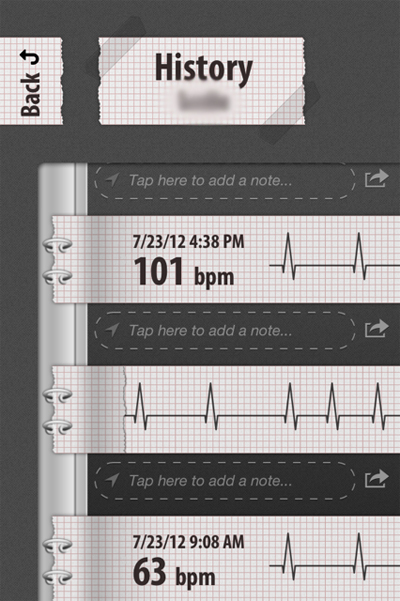
Every time she feels a symptom, she places her index finder over the camera on the phone, waits a bit, and records a make-believe rhythm strip representing each heart rhythm. With it, comes the date and time. When the rhythm is in sinus, she learned that her heart rhythm was typically in the 60's at rest:

When the rhythm was in afib, it was considerably higher and sometimes displayed an irregular rhythm:

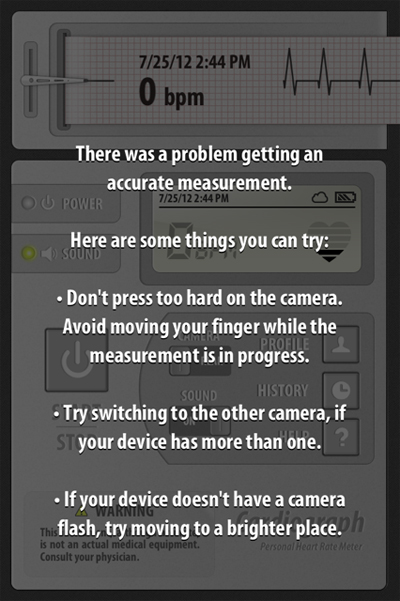
or sometimes it displayed an error message:

I got a relative picture of how often she was having afib and she got the opportunity to help me with her care.
Was this a medical device? No, it was an iPhone app.
Was it perfect? No it wasn't. I certainly couldn't differentiate frequent PAC's or PVC's from atrial fibrillation reliably. It was NOT an EKG after all. But we were past that point in her evaluation. I just needed to know how often she was having her known paroxysmal atrial fibrillation and she wanted to keep a convenient record of her episodes.
Was it helpful in this case? Absolutely.
More importantly, she just saved herself and the health care system a ton of money.
Welcome, my friends, to the era of patient-empowered, individualized medicine and a whole new era of patient care. Now, if we can just keep the FDA from screwing things up.
-Wes
PS: I have no commercial interest in the Cardiograph app and do not endorse it as a standard of care, but merely use this case to demonstrate how innovation can facilitate cheaper, equally-effective health care in some cases. I'd also like to thank my patient for allowing me to use her screen shots.
Today in my clinic, a patient brought me her atrial fibrillation burden history on her iPhone and it cost her less than a $10 co-pay. For $1.99 US, she downloaded the iPhone app Cardiograph to her iPhone.
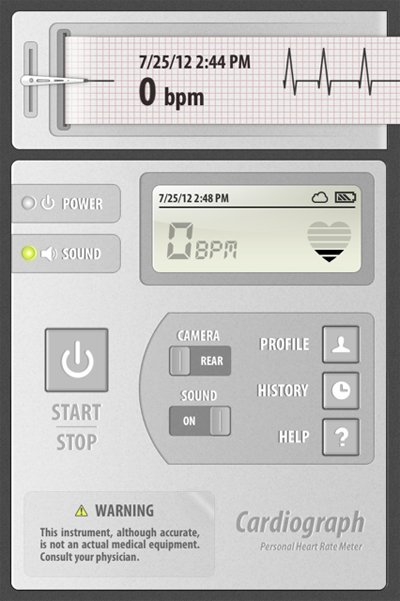
Every time she feels a symptom, she places her index finder over the camera on the phone, waits a bit, and records a make-believe rhythm strip representing each heart rhythm. With it, comes the date and time. When the rhythm is in sinus, she learned that her heart rhythm was typically in the 60's at rest:

When the rhythm was in afib, it was considerably higher and sometimes displayed an irregular rhythm:
or sometimes it displayed an error message:
I got a relative picture of how often she was having afib and she got the opportunity to help me with her care.
Was this a medical device? No, it was an iPhone app.
Was it perfect? No it wasn't. I certainly couldn't differentiate frequent PAC's or PVC's from atrial fibrillation reliably. It was NOT an EKG after all. But we were past that point in her evaluation. I just needed to know how often she was having her known paroxysmal atrial fibrillation and she wanted to keep a convenient record of her episodes.
Was it helpful in this case? Absolutely.
More importantly, she just saved herself and the health care system a ton of money.
Welcome, my friends, to the era of patient-empowered, individualized medicine and a whole new era of patient care. Now, if we can just keep the FDA from screwing things up.
-Wes
PS: I have no commercial interest in the Cardiograph app and do not endorse it as a standard of care, but merely use this case to demonstrate how innovation can facilitate cheaper, equally-effective health care in some cases. I'd also like to thank my patient for allowing me to use her screen shots.
Tuesday, July 24, 2012
The Academic Squeeze Play
If you want to succeed in academic cardiology, get a federal grant for research.
Better yet: get a few well-paid industry grants, too.
These days lower-paid academic cardiologists are finding it tougher to find protected time for research and speaking because grants are harder to come by and money from their academic center is getting tight. For instance, the National Heart, Lung and Blood Institute (NHLBI) of the NIH no longer accepts investigator-innitiated innovative research grant program (R21), which was an important source of funding for researchers and has cut funding lines for established research funding grants (R01) from 15% to 10% acceptance rate. Medical device and pharmaceutical are also feeling the financial squeeze from diminished demand for their devices and boutique drugs (not to mention higher fees for the right to sell them in the US marketplace). Even worse, the federal government has less need for innovation in cardiology now but more need for "demonstration projects" for health care reform.
It's hard to write passionately about health care reform when your real gig is writing about cardiovascular drugs or devices.
And cardiology is still a procedural field that pays hospital systems pretty well. This presents another tough reality for academic cardiologists: they have to generate revenue somehow. Cash-strapped hospitals across the country are looking at challenged bottom lines. They are turning the heat on their revenue pipelines - all of them. Since cardiology is one of those pipelines, the days of stroking one's chin while researching sarcomeres has quickly evaporated to clinical productivity clauses.
And for academic cardiologists once content to research and pontificate on treatment strategies, they are learning the cold, hard reality that speaking gigs and guideline writing doesn't generate revenue for their center.
But there's still an out - a way forward for academic cardiologists everywhere, if you will.
In the increasingly competitive and evolving health care markets of America, there is a need for brand name doctor-managers: folks with marketing marquis value can drive clinical referrals to more clinical centers while serving as intermediaries between hospital administrators struggling to mesh newly hired cardiology groups with their former core cardiologist-employees. How successful these poster-children for health care innovation will be in their newly-created positions remains to be seen, but the demand is there and the migration's on. Lucrative pastures await for fairly low-paid academic cardiologists as health care consortiums grapple for ways to differentiate themselves from their competitors.
So like the mice in "Who Moved My Cheese," academic cardiologists are beginning to make their move and no ivory-tower academic medical center is safe.
-Wes
Sunday, July 22, 2012
The Need to Denigrate Physicians
This morning's lead editorial in the Sunday edition of the New York Times was entitled "A Formula for Cutting Health Costs" and contained the byline "Alaska natives have something to teach doctors and patients in the rest of the world."
I read the editorial with interest, hoping that a new perspective, vision, idea, or insight would be mentioned that would provide a sustainable cost solution to our health care crisis in America. After all, America desperately needs solutions to this conundrum.
We learn in the editorial how the Southcentral Foundation in Anchorage, Alaska treating rural patients " has achieved astonishing results in improving health of its enrollees while cutting costs in treating them."
Sadly, cost saving information was not provided.
Instead, we read that "such a transformation would require upfront financing for training, data processing and the like, but the investment should (emphasis mine) rapidly pay off in reduced costs."
The article states that because of their efforts, "emergency room use has been reduced by 53%, specialty care visits by 65% and visits to primary care doctors by 36%." The editors claim "these efficiencies have clearly saved money" while saying in the same breath that spending of hospital services grew "by a tiny 7%" and its spending in primary care grew by 30% . How do they explain this growth as cost savings in the editorial? They do so by claiming that 30% growth was "still well below the 40% increase posted in the national index issued by the Medical Group Management Association."
But revenues grew too - substantially. According to Southcentral Foundation's own press release, "total revenue has consistently increased from $120.2 million in 2003 to $201.3 million in 2010, exceeding the Medical Group Management Association (MGMA) 90th percentile in 2010. Third-party payer revenue increased from $7.4 million to $17.9 million in the same time period, also exceeding the MGMA 90th percentile in 2010."
In truth, cost of care was not reduced nor was the quantity of care. What we actually have learned is the health care bill in Alaska has continued to grow at a pace that outstrips inflation while the editors of the sit back in their eames chairs and want to teach doctors a lesson.
After all, is is clear that the editors feel doctors are the problem. To the editors, doctors are the disdainers, loomers, and miscreants who must be given no place "to which they can retreat." Instead, if one is to believe the tone of the article, health care providers are optimally corralled, viewed in the open, and perhaps supervised by a lifeguard with a whistle. In the same breath the authors recommend establishing "trust and long-term relationships between patients and providers." This sounds nice until one realizes trust and long-term relationships between the patients and providers will be built (in their view) by "data mall" graphics that spur the "laggards" into compliance.
The editors continue with their scolding, pernicious nanny-state view by criticizing other providers and health care organizations who can't "summon the energy to transform their operations" to the Utopian vision put forth by this piece.
Perhaps most concerning for physicians is the sinister undertone that is becoming increasingly prevalent in some circles of main stream media. Presently doctors are facing huge cuts to their pay as part of the health care reform efforts underway. If the public is going to accept this as best for their own interest, then the editors have firmly established that physicians and hard working care providers are going to have to be subtly and constantly denigrated.
It is a shame that our health care reform discussion has come to this. Rather than enlisting physicians as part of the solution, we're now the problem.
Remember that when you can't get an appointment.
-Wes
Addendum 0912 am 23 Jul 2012:
Thanks to those that sent on these other examples of ongoing denigration of physicians:
Whitecoat's Call Room blog: Jim Dwyer New York Times - Irresponsible Journalism?
A follow-up post appears on the same blog continuing the conversation:
Jim Dwyer New York Times Pediatric Fever Article Debate
Dr. Malpani's Blog: Doctor Bashing in the Media
Tuesday, July 17, 2012
Lessons from EKG Class
"Dr. Fisher, can you teach our residents EKG lecture series?"
Naively, I said "Sure!"
What I didn't realize is how hard this is to do today.
Much of this is not residents' fault. They only have so many hours in so many days to attend lectures while caring for patients. Thanks to residency work-hour restrictions, those hours have become even fewer. To make matters much worse, through the year residents are torn to different rotations at different times and different hospitals. Since topics for EKG interpretation span over many lectures, it is impossible for residents to attend every lecture over the academic residency year. Just like when a student misses half the lectures for a college course, it's hard to get an A.
Yesterday, I stood before a crowded room of about 35-40 residents and interns for their first of many EKG classes. There they sat, with their nicely pressed florescent-white lab coats ready to learn. They were quiet and respectful as they sized up their middle-aged physician attending who apologetically arrived 5 minutes late after seeing an urgent consult in the Emergency Room. They had no idea what to expect. I some ways, neither did I.
I plugged in the obligatory USB thumb drive to the obligatory computer to display the obligatory Powerpoint presentation, then stopped. Up came the image on the screen. They turned toward it, oblivious how uninterested I was in the contents of the slide. I asked them a question.
"How many of you don't know the first thing about an EKG?"
Their heads swung back to me, silently. Much of the room smiled, not certain where I was going. Hesitantly, a few hands rose in the air.
I had never seen this before. As their soon-to-be instructor, I could not help but ask myself silently what the heck these kids have spent at least $200,000 of their parents' money learning in medical school. How on earth can any student leave four years of medical school education and not know the first thing about an EKG?
I pressed on.
"How many of you know something about an EKG and its basics but realize you need to know more?"
Relieved, I saw many more hands go up.
EKG reading is one of those basic skills that every physician should at least have a rudimentary knowledge. Medical school's controlled classroom-like environment lends itself better to instruction of the basics rather than hurried clinical rotations. Clinical rotations are where residents should fine-tune their skills in this area. How and why some medical students are not even exposed to this basic skill before entering their internship is one question, but what these young doctors are receiving for their huge costs of education is even a more important one.
As pressures continue to mount on physician salaries in the years ahead and their corresponding debts mount, perhaps we should ask ourselves why our young doctors continue to pay huge sums for their medical education of when the quality of the instruction has been allowed to slip to this level.
Could it be their academic instuctors never attended an EKG class either?
-Wes
Friday, July 13, 2012
Happy Friday
We sat in the dining room, catching up on the week's events. My colleague, ever insightful, turned to me and said, "Wes, as you know, I'm a regular reader of your blog but, dang, it sure has been depressing to read lately."
Looking back at the week and the topics discussed, I suppose he was right. Everything I mentioned about "Today's Primary Care," the "Destructiveness of Measures," "Is the Electronic Medical Record Full of Lies?" and "The Challenges of Team Medicine" doesn't sound very cheery, I suppose.
Sorry about that.
But someone has to tell these stories. They are important. As doctors who directly deliver health care to our patients, I believe that it is important to remind people that the Utopian vision for medical care that is being created is still not perfect despite how it's being sold to the public. Admittedly, it wasn't perfect before either and it needed to be changed. But as we move forward, all of us should appreciate that there are trade-offs in many of the so-called electronic and practice "efficiencies" and "requirements" that are being bestowed upon doctors today. I worry that too often, online doctors are so concerned how they are perceived publically that few dare speak out when things are amiss. In essence, the permanence of the online world paired with sounding too adversarial, coerces doctors to become forever politically correct. We should not underestimate the problems for doctors as they progress professionally when they go against the grain. We walk a very thin line. My hope, of course, is that with real live discourse on this little blog, our central planners of our next New World of health care might stumble upon our thoughts and at least consider the unintended consequences of their actions and (who knows?) move to improve the status quo. Doctors must be part of the solution after all.
So have a nice weekend. Realize that I really do love my patients and my job. Understand that I am sensitive to sounding too negative, but also know that I'm callin' 'em as I'm seein' 'em, and I'm definitely not making this stuff up.
-Wes
Wednesday, July 11, 2012
Is the Electronic Medical Record Full of Lies?
In a provocative piece in the Journal of the American Medical Association (JAMA), Elizabeth Toll, MD pens a powerful portrait of what the Electronic Medical Record have brought to the doctor-patient relationship, describing both its benefits and its limitations (be sure to see the 7 year-old's precient drawing as well). Perhaps most disturbing was this passage in her essay:
This essay has not been lost on the Electronic Medical Record industry. They are feeling the pushback of doctors who are insisting not just more information, but better information and better efficiencies. In a phone interview, Dr. Toll took some of these concerns further:
Cut and paste has its efficiencies and its downfalls. When audits happen to justify billing and innacurate copied paragraphs are found to fill the doctors' note, how will hospital systems respond?
-Wes
There is a certain irony to all this. For years, we’ve been hearing that focusing on our patients as people, improving communication, admitting mistakes, and creating patient- and family-centered care will make us better physicians, gratify patients, and prevent lawsuits. In fact, professionalism and communication are core components of the residency training curriculum. Medical schools have begun to insist that applicants demonstrate proficiency in the humanities and social sciences, as well as the traditional hard sciences. So, to watch these directives shift with the mandate of the EMR seems a sad reversal of progress and common sense.
All this is not lost on our patients. In addition to the young artist, whose drawing speaks volumes, wherever I go in or out of the medical world these days, I hear patients' observations: “My doctor hasn't made eye contact with me since he got on that computer—he's not a very good typist.” “Our visits are rushed. My doctor used to have time to listen to my concerns, but now she spends a lot of time complaining about how hard her workday is.” Physician colleagues pour out similar comments: “In the past I would see a patient, write a note, close the chart, and spend a moment reflecting on the visit. Now my time goes to fighting with the computer and chasing down my colleagues to get them to lock their notes, so we can submit bills.” “I feel pulled in so many directions, like my brain is scattered. I went into medicine to work with people, but now I’m in front of a computer screen all day, managing systems. I still love my patients, but I hate how I’m spending my time.”
This essay has not been lost on the Electronic Medical Record industry. They are feeling the pushback of doctors who are insisting not just more information, but better information and better efficiencies. In a phone interview, Dr. Toll took some of these concerns further:
The EMR was designed to demonstrate the pieces of the record that you have to attend to in order to bill at a certain level. If you just enter a few questions and you only enter part of the exam, and you only add medicines and you only do this or that, you can only be reimbursed a certain amount. But if you asked about, for instance, the family history, the surgical history and the social history, then you have all the elements to charge more. So there’s an incredible temptation to just push, push, push and bring forward everything from the previous notes without re-asking the questions.
This creates a huge problem: The records are full of lies. They’re full of things that [physicians] have said they’ve done but truly haven’t. The patient has been in eighth grade for three years. The patients are divorced, but in the record they’re still married. The patient used to work as a nurse and now works as a librarian, but it hasn’t been changed in the record because people are giving quick, push-button answers to save time, and they don’t update the info. You can see this as you go through small things in the social history but also in [clinical histories]. Yesterday, someone sent me a letter about an amputee patient he sent to a podiatrist. He got a report back on both the patient’s feet. This patient only has one foot.
Cut and paste has its efficiencies and its downfalls. When audits happen to justify billing and innacurate copied paragraphs are found to fill the doctors' note, how will hospital systems respond?
-Wes
Monday, July 09, 2012
EKG Du Jour #26 - The Eveready Energizer Pseudo-Infarction
Courtesy of the June, 2012 issue of the J Am College of Cardiology, I give you this fascinating case report of a suicide attempt using 6 ingested cylindrical AAA batteries that created, literally, an injury current on the patient's surface EKG:
I must say, I've never seen an Eveready Energizer pseudo-infarction like this before.
Read the whole case report here.
-Wes
Reference:
Addendum 10 JUL 2012 14:15 PM CST:
This EKG probably warrants a letter to the editor of JACC. First of all, as has been pointed out by several individuals on Twitter (thanks @mzkhalil and @tobymarkowitz), it would be unusual for DC current to affect only the ST segment of the patient's EKG. Other causes of these findings include hyperventillation syndrome, coronary vasospasm (though this is usually associated with chest discomfort) or CNS disease to the EKG findings of an acute injury pattern, neither of which were discussed as possible causes for the findings, rather than a direct cause-and-effect of DC current from ingested batteries.
At least that's my two cents.
-Wes
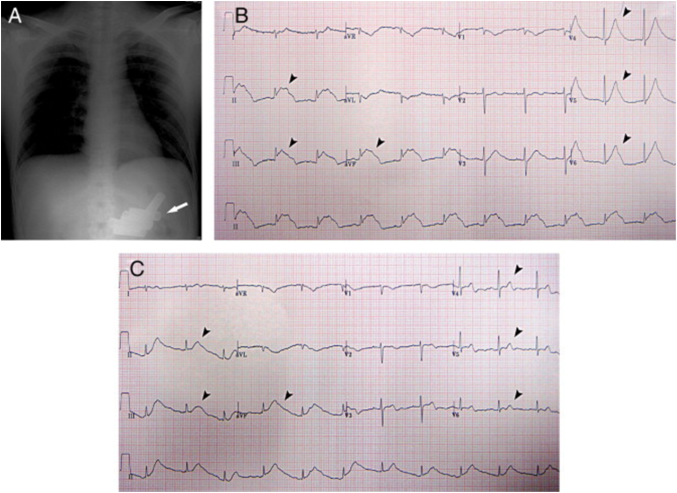 |
| Panel A- CXR of batteries in stomach, Panel B- Presenting EKG Panel C- EKG after batteries removed (Click image to enlarge) |
Read the whole case report here.
-Wes
Reference:
Chang H, Hu S, Tsai M. J Am Coll Cardiol. 2012;59(25):2387-2387. doi:10.1016/j.jacc.2011.11.073
Addendum 10 JUL 2012 14:15 PM CST:
This EKG probably warrants a letter to the editor of JACC. First of all, as has been pointed out by several individuals on Twitter (thanks @mzkhalil and @tobymarkowitz), it would be unusual for DC current to affect only the ST segment of the patient's EKG. Other causes of these findings include hyperventillation syndrome, coronary vasospasm (though this is usually associated with chest discomfort) or CNS disease to the EKG findings of an acute injury pattern, neither of which were discussed as possible causes for the findings, rather than a direct cause-and-effect of DC current from ingested batteries.
At least that's my two cents.
-Wes
Sunday, July 08, 2012
Affordable But Inconvenient Health Care
 |
| Empty Medical Office Building, Florissant, MO (Click to enlarge) |
Didn't think so.
While health care reform has benefitted large health care systems, it continues to decimate small practice physicians. This portends an ominous outlook for health care in small-town and rural communities. From Medscape Cardiology (registration required):
One third of physicians in small group practices who responded to a recent survey expect their 2012 income to fall below what they earned last year. Financial pressures could have a devastating effect on physicians in practices of 10 or fewer participants: 26% surveyed said they might have to close their practice within the next 12 months.-Wes
"The survey was emailed in April to a random selection of 15,000 of the 200,000 physicians who are registered members of MDLinx, a medical news website, and 673 responded," a spokesman told Medscape Medical News.
A total of 49% of small practice physicians reported cutting staff and services to reduce operating expenses. Despite such measures, 23% said they have used personal savings, and 20% have had to borrow money to cover expenses.
By comparison, only 13% of physicians at larger practices or hospitals expected their income to drop this year.
"This poll is quite startling in the revelations about small practices, the healthcare lifelines to many communities," said Stephen Smith, chief marketing officer for MDLinx. "Physicians have had missiles raining in on their practices at an increasing pace—the economy, regulations, paperwork, insurance, lawsuits, etc."
... "The coming retraction this survey hints at," said Smith, "would mean longer drives to less-personal, higher-cost medical care for millions of Americans."
Saturday, July 07, 2012

Friday, July 06, 2012
Thursday, July 05, 2012
The Destructiveness of Measures
A little box pops up before him asking if he asked the patient about the exercise. He mumbles something under his breath, clicks a little box beneath the question, then moves on.
This is what medicine has become: a series of computer queries and measures of clicks. It must be measurable, quantifiable, and justifiable or it didn't happen.
Do they ask if I asked them about if they used cocaine? Of course not: too politically incorrect.
Do they ask if I really listened to their heart? Of course not - this activity is not a paid activity.
Do they ask about the myriad of phone calls and e-mails to arrange for a procedure? Nope.
Do they measure my time with the patient when I go back to see them on the same day? Nope- not paid for.
So what's the motivation for doctors to be doctors? Are we retraining our doctors from care-givers to data providers? What are we losing in turn?
Today, an excellent opinion piece by Daniel Henniger appeared in today's Wall Street Journal. In it, he references an important article by Drs. Christine Cassel and Sachin H Jain published in the June 17th issue of JAMA entitled "Assessing Individual Physician Performance: Does Measurement Suppress Motivation." Cassel and Jain are two shapers of the Pay-for-Performance movement but acknowledge the danger this movement has on physician behavior:
Doctors are losing their motivation to diagnose in favor of sitting at a computer. Doctors, I also dare say, are losing their skills in favor of sitting at a computer. Clicking buttons has such importance to health care systems that these performance measures are being linked, in part, to doctors' salaries. As a result, young doctors are losing their complex problem solving skills in favor of making sure they click on every result that comes to their inbox, lest they be seen as nonproductive. This, you see, is what matters to employers.
We are reshaping medicine away from the bedside to the computer.
We'd better understand the damage this shift is causing before our young physicians of tomorrow don't know any better.
-Wes
This is what medicine has become: a series of computer queries and measures of clicks. It must be measurable, quantifiable, and justifiable or it didn't happen.
Do they ask if I asked them about if they used cocaine? Of course not: too politically incorrect.
Do they ask if I really listened to their heart? Of course not - this activity is not a paid activity.
Do they ask about the myriad of phone calls and e-mails to arrange for a procedure? Nope.
Do they measure my time with the patient when I go back to see them on the same day? Nope- not paid for.
So what's the motivation for doctors to be doctors? Are we retraining our doctors from care-givers to data providers? What are we losing in turn?
Today, an excellent opinion piece by Daniel Henniger appeared in today's Wall Street Journal. In it, he references an important article by Drs. Christine Cassel and Sachin H Jain published in the June 17th issue of JAMA entitled "Assessing Individual Physician Performance: Does Measurement Suppress Motivation." Cassel and Jain are two shapers of the Pay-for-Performance movement but acknowledge the danger this movement has on physician behavior:
Overstating the value of discrete quality measures has the potential to demotivate and demoralize physicians who appropriately view their job as much more than simply meeting a standardized measure set.This point cannot be overemphasized.
Doctors are losing their motivation to diagnose in favor of sitting at a computer. Doctors, I also dare say, are losing their skills in favor of sitting at a computer. Clicking buttons has such importance to health care systems that these performance measures are being linked, in part, to doctors' salaries. As a result, young doctors are losing their complex problem solving skills in favor of making sure they click on every result that comes to their inbox, lest they be seen as nonproductive. This, you see, is what matters to employers.
We are reshaping medicine away from the bedside to the computer.
We'd better understand the damage this shift is causing before our young physicians of tomorrow don't know any better.
-Wes
Monday, July 02, 2012
The Challenges of Team Medicine
Shuzan, a Buddhist monk of the tenth century, once held up a bamboo stick before his disciples. "Call this a stick," he bellowed, "and you assert; call this not a stick, and you negate. Now, do not assert or negate, what would you call this stick? Speak! Speak!"
From out the ranks, a young monk ventured forth, grabbed the bamboo, and, breaking it in two, exclaimed to Shuzan, "What is this?"*
Team-based patient care, that is, care involving multiple attending physicians from multiple services, multiple residents under work-hour restrictions, and a compendium of pharmacists, nurse practitioners, social workers, physical therapists and occupational therapists and the like -- seems to be the latest, greatest fad in medical care these days, especially in large health care systems. While there are many advantages in this approach, there is also a disturbing shortcoming that I seem to be observing: something I’ll call dilution of responsibility.
This phenomenon should not be confused with the "hand-off" errors we've heard so much about. Rather, this phenomenon is more insidious. Today, more attending physicians have responsibility for an individual patient at varying times during their inpatient treatment than ever before. For instance, there are ICU attendings, ward/teaching attendings, hospitalist attendings, outpatient attendings (who may or may not want to participate in inpatient care), and specialty attendings - each with their niche of inpatient care.
These days as a consulting physician, for instance, I often wonder after writing my consult that contains recommendations for therapy if I should also write the orders on a patient. In the past, this never happened. Back in earlier times, the senior residents served as the "Commander and Chief" of inpatient care. Attendings were not allowed to enter orders on a patient. That way, the senior resident, in concert with his responsible attending, knew what was and wasn't to happen with a patient. Everyone caring for the patient knew who had ultimate responsibility to make things happen. With our new model of "team-based care" our Commander in Chief is lost. It is becoming increasingly difficult to know if team caregivers are reading my recommendations and deciding to ignore them or just figuring someone else will implement them. How do I, as a “consultant,” know? Too often, omissions of therapy and the rationale for such are not communicated by today’s disparate and tunnel-visioned caregivers. Leadership is not easily assumed when everyone feels they are the leader.
With the trend of larger health systems under growing price pressures, I also see a growing trend to cross-train clinical and technical personnel across disciplines. No where is this more evident than in the cardiac catheterization and electrophysiology laboratories, for instance. From a manpower standpoint, this makes good sense. But we also risk making these clinical and technical personnel slaves to many but masters at none. It is a fine line that is constantly challenged these days: quantity of care over quality of care. Larger health systems with multiple hospitals, each with their separate laboratories amplify these challenges. In such a construct, not only are personnel required to know many areas of expertise, but also the many locations where the same piece of equipment might reside as well. Checklists, in cases like this, can only go so far.
These are the challenges doctors face going forward as physicians ultimately responsible for our patients’ well-being in our new era of team-based care. In many respects, these challenges are not new. But administrators squeezed by cost concerns should also be sensitive to the growing challenges caregivers encounter in this environment.
And doctors, like the young monk who steps forward in the story at the beginning of this post, mustn’t forget how to take the stick.
After all, the computers won't do it for us.
-Wes
And doctors, like the young monk who steps forward in the story at the beginning of this post, mustn’t forget how to take the stick.
After all, the computers won't do it for us.
-Wes
* From: An Introduction to Zen Buddhism, by D.T. Suzuki (Grove Press, 1964).
Subscribe to:
Posts (Atom)