It had been a long day: a book chapter due, tons of consults, too little sleep, procedures. So when I had a minute to grab a little respite from the chaos while nature called, I took it. I sat on the throne to ponder the day. I needn’t go into gory details. But when I stood up, I heard a “plunck.”
“What the…?”
And I turned around and saw it. My pager. In the toilet.
Now one must make some serious decisions quickly in this situation.
Like, “do I get it or flush it?” Hmmm.
Oh, hell, I’m a doctor. So I grabbed it quickly.
Then rinsed it. And I washed and washed my hands, mind you. No Purell for me! Nope, I don’t trust that crummy residue it leaves on your hands. Lots and lots of soap and water. Then chlorhexidine just to be careful.
But then I realized I had not checked the patient.
“Pager, pager are you alright?”
No response.
“Quick, call 911!”
Thinking quickly, I removed the battery cover and extracted the battery. I shook it dry. Still no response.
Then I couldn’t remember – is it 15 button pushes to two hard breaths or 5 button pushes to 1 hard breath? Feeling that hypoxia and drowning were the most likely cause of sudden death, I chose the latter. Do I push the buttons half an inch or a quarter of an inch? Oh hell, I don't know. How old was she? I should have probably used epinephrine, atropine, or isoproterenol, but felt this might be one patient where a “quick code” might be in everyone’s best interest. After all, I had had her for about 6 years, and someone had her before me. It was time.
So I called the code. Time of death: 07:12 AM.
But as an electrophysiologist, I decided that water might have induced electronic hypothermia, so I gave one more thing a try...
... I slowly rewarmed the patient by placing her above an incandescent bulb while saying her last rights. "Rest easy," I said and borrowed another pager.
Later that night, I returned to the patient to check on her. I replaced the battery, inspected for a pulse and “viola',” tones chirped from her underbelly! A successful resuscitation at last!
Damn.
-Wes
Thursday, November 30, 2006


Wednesday, November 29, 2006
The New Shareware?
Wow. Intel, Wal-Mart, and British Petroleum are joining hands (subscription required) in a "Kum Ba Ya" moment to try to develop an Electronic Medical Record (EMR) for their employees, housed on their own data warehouse creating the ultimate in shareware.
Hospitals, doctors, insurers, and the employers will have unfettered access to those records, but "they will belong to the employee." *Sigh*
But perhaps this data-sharing could be a good thing: fewer repeated tests, better continuity of care, a central repository of information where a consistent standard of information can be located. And yes, a wonderful place to see which doctors and hospitals are "performing" and which are not: who to pay, and who not to pay.
Employers are fed up with rising health costs and are rustling up their sleeves to do something about it. This, folks, is gonna happen.
The biggest issue now facing us: health care policy has to keep up with the advances in the EMRs being developed, or once your data is out there in the electronic ethos, it's out there for the millenium, just like, as the article says, "a Paris Hilton sex video."
-Wes
Tuesday, November 28, 2006
FDA and Pharma: Bed Partners?
After my Plaquequest post yesterday, I looked into the partnership arrangement between the FDA and BG Medicine a bit more today and found this statement from the FDA's own press release:
I wonder.
Sure makes those pens and lunches from drug reps seem like chump change, doesn't it?
Anybody else want to weigh in on this?
-Wes
The agency ... concluded an agreement with BG Medicine, a biotechnology research company, to collaborate on discovering signs of liver toxicity in the initial stages of drug development.BG Medicine's press release was a bit more detailed:
25 Oct 2005: BG Medicine, a Massachusetts-based biotechnology research company, today announced the submission of a Cooperative Research and Development Agreement (CRADA) with the Food and Drug Administration's National Center for Toxicological Research (NCTR), to jointly conduct a liver toxicity study designed to overcome one of the primary obstacles to the efficient development of safe and effective drugs. The study, Liver Toxicology Biomarker Study (LTBS), aims to discover biomarkers of human hepatotoxicity in the standard test used by pharmaceutical manufacturers in the initial stages of drug development.Now I'm not sure what I think about this. The FDA is supposed to assure the safety of pharmaceuticals to the public. While the bureaucratic quagmire called the FDA certainly needs to streamline their approval of drugs, are they able to maintain their objectivity regarding drug evaluations when they've become "best buddies" with the pharmaceutical industry by using Big Pharma's funds and facilities like this?
Liver toxicity is the most common biological reason for drug failure in the development of new pharmaceuticals, affecting one in six drugs in development. The toxicity tests currently in use by drug companies have been unchanged for at least 40 years and often fail to identify human liver toxicity issues. Consequently, liver toxicity is often detected for the first time when drugs are in phase 2 of clinical testing after tens of millions of dollars or more have been spent on a drug.
On March 16, 2004 the FDA released a report, "Innovation/Stagnation: Challenge and Opportunity on the Critical Path to New Medical Products," describing the "urgent need to modernize the medical product development process -- the Critical Path -- to make product development more predictable and less costly." The proposed project addresses the liver toxicity issue highlighted in the Critical Path document as one of the obvious and priority areas for innovation.
The CRADA process is a standard procedure for studies the FDA undertakes in collaboration with private companies. The liver toxicity study has been designed by BG Medicine and the FDA with input from a number of pharmaceutical companies. The study will be funded by and conducted in collaboration with pharmaceutical manufacturers. (Emphasis mine)
The research project leverages NCTR's and BGM's systems biology platforms for functional genomics, proteomics, metabolomics and computational analysis.
The LTBS will be conducted at the FDA's NCTR laboratory in Jefferson, Arkansas and at BG Medicine in Waltham, Massachusetts. The study is open to participation by all pharmaceutical manufacturers. Participating companies will receive a paid-up perpetual license to any biomarkers discovered and access to all project data.
I wonder.
Sure makes those pens and lunches from drug reps seem like chump change, doesn't it?
Anybody else want to weigh in on this?
-Wes
Played for Performance
Pay for Performance: To think our government, legislators, and insurance yahoos want to implement this for Medicare payments to physicians and hospitals. Look what it has come to in England.
Yuck.
-Wes
Yuck.
-Wes
Monday, November 27, 2006
Plaquequest
Today the hunt for the vulnerable plaque will begin in earnest. It's not a new adventure, but one I like to think of a "Plaquequest."
"Vulnerable plaque" is the plaque within an artery that can suddenly "rupture" and stimulate the rapid formation of clot within a coronary artery, compromising blood flow to a portion of heart muscle, and leading to a heart attack. Cardiologists have long recognized that tightly narrowed arteries are not necessarily the ones that suddenly occlude during a heart attack; sometimes only modestly narrowed arteries become abruptly occluded. This has lead to a search for ways to identify which plaques are vulnerable to rupture before rupture occurs, potentially saving lives and heart muscle.
A consortium of researchers are assembling to attempt to identify vulnerable plaque. To the tune of $30 million. It is a huge undertaking, but the pot of gold at the end of the rainbow is just too tempting for industry to ignore. It is not surprizing that Merck and Astra Zeneca, two large pharmaceutical companies have joined the hunt. But BG Medical? Who are they? Described as a new "start-up company" in the New York Times, it's really a consortium of pharmaceutical and imaging industry interests including Astra Zeneca, Boehringer Ingelheim, Biorosettex, GlaxoSmithKline, Philips, Mitsubishi Pharma Corporation, the "Global Alliance for TB Drug Development" (what has tuberculosis got to do with this? I wonder if their membership is happy about this investment, but I digress) and...
..the FDA.
Really? The Food and Drug Administration is now a "Partner" with BG Medical? Maybe so. At least they're listed on BG Medical's "Innovative Paths to a Trusted Partner" page on their website. Certainly, there have been concerns regarding conflicts of interest with the FDA's "Special Government Employees" that advise the FDA having conflicts of interests with the pharmaceutical industry and what needs to be disclosed to the public. But to this doctor, the FDA itself has a responsibility to the public at large to maintain objectivity in its oversight of new drugs during the approval process. Certainly this partnership of the FDA itself with BG Medical violates the public's trust.
Oh, but we needn't stop here.
Look who else is "partnering" in Plaquequest: Humana, a manager of health care insurance plans.
Plaquequest is a noble goal indeed. Going after arteries already blocked is a $6 billion stent market. $20 billion more are spent for statin drugs for primary and secondary prevention of coronary disease presently. It seems clear that the drug and device industry wants to know if they can boldly grow this market so cardiologists can place stents in asymptomatic arteries cloaked under the "vulnerability" guise. Interesting, but will this work?
Lets say this research succeeds at Plaquequest. How do we apply this finding to John Q. Public? Do we then place a stent there knowing it could thrombose as a result of the stent being there? Or should we place everyone on a statin drug as we've already been recommended for anyone with significant hyperlipidemia. Doctors haven't historically been so good at even this simple recommendation. And imaging to screen for vulnerable plaque is expensive: who is going to pay for massive screening tests? (Take a guess) So what have we gained?
It's hard to know. Maybe some new drugs or insights to the mechanism of acute coronary syndromes will be discovered, leading to new research paths for these great companies. But I hope Plaquequest is more than a means for Humana to get more best practice and cost analysis data while doctors get to feel good that the pharmaceutical and medical imaging industry has "given back" to research centers, and maybe the FDA.
-Wes
"Vulnerable plaque" is the plaque within an artery that can suddenly "rupture" and stimulate the rapid formation of clot within a coronary artery, compromising blood flow to a portion of heart muscle, and leading to a heart attack. Cardiologists have long recognized that tightly narrowed arteries are not necessarily the ones that suddenly occlude during a heart attack; sometimes only modestly narrowed arteries become abruptly occluded. This has lead to a search for ways to identify which plaques are vulnerable to rupture before rupture occurs, potentially saving lives and heart muscle.
A consortium of researchers are assembling to attempt to identify vulnerable plaque. To the tune of $30 million. It is a huge undertaking, but the pot of gold at the end of the rainbow is just too tempting for industry to ignore. It is not surprizing that Merck and Astra Zeneca, two large pharmaceutical companies have joined the hunt. But BG Medical? Who are they? Described as a new "start-up company" in the New York Times, it's really a consortium of pharmaceutical and imaging industry interests including Astra Zeneca, Boehringer Ingelheim, Biorosettex, GlaxoSmithKline, Philips, Mitsubishi Pharma Corporation, the "Global Alliance for TB Drug Development" (what has tuberculosis got to do with this? I wonder if their membership is happy about this investment, but I digress) and...
..the FDA.
Really? The Food and Drug Administration is now a "Partner" with BG Medical? Maybe so. At least they're listed on BG Medical's "Innovative Paths to a Trusted Partner" page on their website. Certainly, there have been concerns regarding conflicts of interest with the FDA's "Special Government Employees" that advise the FDA having conflicts of interests with the pharmaceutical industry and what needs to be disclosed to the public. But to this doctor, the FDA itself has a responsibility to the public at large to maintain objectivity in its oversight of new drugs during the approval process. Certainly this partnership of the FDA itself with BG Medical violates the public's trust.
Oh, but we needn't stop here.
Look who else is "partnering" in Plaquequest: Humana, a manager of health care insurance plans.
The centerpiece of the research will be a study of 4,000 to 6,000 Humana patients with at least two known risk factors for heart attacks. As the outcome for the patients becomes clear over the next few years, researchers hope the profiles that emerge from the study will, in hindsight, show patterns pointing directly to the high-risk patients who actually suffered heart attacks. That in turn could help the companies create new therapeutic products.I'm not sure of their motivation here, but I wonder how much revenue and "best practices data" they receive for supplying the patients for this trial. Hmmm. It seems only Humana patients will be participating in this "research." Why?
Plaquequest is a noble goal indeed. Going after arteries already blocked is a $6 billion stent market. $20 billion more are spent for statin drugs for primary and secondary prevention of coronary disease presently. It seems clear that the drug and device industry wants to know if they can boldly grow this market so cardiologists can place stents in asymptomatic arteries cloaked under the "vulnerability" guise. Interesting, but will this work?
Lets say this research succeeds at Plaquequest. How do we apply this finding to John Q. Public? Do we then place a stent there knowing it could thrombose as a result of the stent being there? Or should we place everyone on a statin drug as we've already been recommended for anyone with significant hyperlipidemia. Doctors haven't historically been so good at even this simple recommendation. And imaging to screen for vulnerable plaque is expensive: who is going to pay for massive screening tests? (Take a guess) So what have we gained?
It's hard to know. Maybe some new drugs or insights to the mechanism of acute coronary syndromes will be discovered, leading to new research paths for these great companies. But I hope Plaquequest is more than a means for Humana to get more best practice and cost analysis data while doctors get to feel good that the pharmaceutical and medical imaging industry has "given back" to research centers, and maybe the FDA.
-Wes
Sunday, November 26, 2006
Infectious Disease: Bad Place for Malpractice Law
It's amazing how fast plantiff's lawyers will dump their clients seeking compensation for acquiring MRSA infections in Kentucky once real data regarding infection rates (and the difficulties with their interpretation) become available.
-Wes
-Wes
Friday, November 24, 2006
James Bond: Saved by A Defibrillator

Tonight I learned that my field, cardiac electrophysiology, has finally reached prime time. If you haven’t had the chance, catch Casino Royale, one of the better James Bond flicks to hit the screen. Lots of action, a slightly more believable plot (can that happen?) and plenty of eye candy for all.
But best of all, I got to watch James (Daniel Craig) try to defibrillate himself! It happens after James Bond is poisoned by as tainted martini with “digoxin” at the poker table. He then develops blurred vision and moderate disorientation, and quickly excuses himself from the poker table. He then staggered to grab a shaker of salt and a glass, and proceeded to the bathroom, where he quickly induced vomiting. He then staggered to his Aston Martin Vanquish and opened the glove compartment…. and there it was: an automatic external defibrillator! Yep, smaller and more compact than commercially-available models, but a defibrillator nonetheless.
It turns out that a small chip implanted in James’ arm told his compatriots back at his headquarters that he was also suffering from “ventricular tachycardia.” He was then told to slap the defibrillator pads to his chest. They first elected to give him an antidote for the digoxin, but it was ineffective, so they proceeded to radio James and instructed him to defibrillate himself. James tries on multiple occasions to deliver the shock unsuccessfully, only to discover one of the connection pins to the defibrillator pads had become unplugged. He loses consciousness before he can replace the pin and collapses in the front seat of his car. Fortunately, his new-found love interest, Vesper Lynd (french actress Eva “OMG” Green), found James, plugged in the pin and proceed to cardiovert poor James back to life. As is true with Hollywood, he awakens unscathed and returns to the poker table, only to tell his arch rival Le Chiffre, “That last hand nearly killed me.”
Classic Bond. Great entertainment. Just a bit unreal, but then again, who wants reality when you can have "Bond,…
… James Bond."
-Wes
Device-based Hypertension Therapy?
All of us have had our blood pressure taken when we visit the doctor's office. Many of us have been told by a doctor that our blood pressure is too high and that we should "watch" it. Few of us, however, leave the doctor's office understanding how serious a health problem high blood pressure is or that it can lead to heart disease, stroke and kidney failure.
It is not that high blood pressure is especially difficult to control. Today's doctors can prescribe a wide range of good, affordable drugs that will lower your blood pressure and help you live a longer, healthier life. The problem is many of them simply don't. Some estimates have suggested that only 30-47% of patients with hypertension receive adequate therapy.
But occasionally, even with lots of medications and careful follow-up, there are a few patients in whom controlling blood pressure can be particularly difficult. For these patients there might be another option soon.
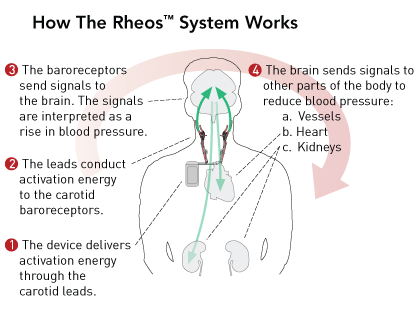
A new pacemaker-like device recently debuted at the American Heart Association meeting in Chicago this year to treat severe, drug–refractory hypertension. Made by CVRx, this device functions by stimulating the carotid bulb at the bifurcation (branch point) of the internal and external carotid arteries to activate the baroreceptor reflex.
The baroreceptor reflex is a normal reflex that the body uses to quickly provide more or less blood pressure to the brain with changes in posture. Elevation in blood pressures causes mechanical stretch of receptors (“baroreceptors”) in the carotid sinus. When stretched, these cells fire electrical impulses faster to stimulate centers in the brain that are responsible for deactivating sympathetic stimuli while activating the parasympathetic (or heart rate slowing and vasodilating portion of the body’s blood-pressure-regulating system to lower blood pressure. By stimulating these baroreceptors, researchers hope to use the body’s own baroreceptor reflex to drive blood pressure lower. The report of piloted patients appeared promising enough for the Food and Drug Administration to grant an Investigational Device Exemption (IDE) to expand the evaluation of the device to a larger cohort of patients.

Figure from the CVRx website
Early European results were reported for 12 patients at the European Society of Hypertension meeting in June 2006. In this study, after three months of active therapy, systolic blood pressure was reduced by an average of 24 mmHg (189 mmHg vs. 165 mmHg). In the preliminary US trial presented at the AHA meeting, three months of active therapy reduced systolic blood pressure by an average of 22 mmHg (180 mmHg vs. 158 mmHg) and diastolic blood pressure by an average of 18 mmHg (105 mmHg vs. 87 mmHg), using office cuff measurements. While data are preliminary at present, this device might become promising.
But there are some significant hurdles for the company to clear before the device can become reality.
First, because hypertension is painless and causes no symptoms until end-organ damage occurs, treating patients with an implantable device will be a hard sell for physicians. Furthermore, many patients with hypertension are simply left untreated by their physicians, or receive inadequate medical therapy. Confounding social and psychological problems, like alcoholism and medication non-compliance, further complicate therapy of hypertension. To think that such cases of hypertension warrant therapy with an implantable device is misguided.
Vanity, as well, will be difficult to overcome. From my experience with pacemakers, patients do not like their scar and associated discomfort occasionally experienced from pacemaker implantation beneath the collar bone (clavicle). Fortunately a shirt can usually cover the scar. But will patients want scars on both side of their neck with this device?
Safety issues also need to be addressed more completely. If the device is too effective in an individual patient and drop their blood pressure precipitously, how will it be inhibited? No sensor exists in the device to sense its effects on a persons’ blood pressure – certainly this is not a minor issue. Further, the baroreflex can cause profound slowing of the heart rate, or even asystole (no heart rate). No mechanism for pacing the heart (or a means of sensing the patient’s heart rate) exists in the device’s current design should a slow heart rhythm occur.
Finally, I hope that patients with renovascular hypertension are sufficiently screened before enrolling in a study using this device. Blocked arteries leading to the kidneys can result in profound medically-refractory blood pressure elevations and should be excluded before implanting this device.
In summary, the concept is interesting, but significant refinements are required before this device reaches the broader public. For now, treating hypertension early and often with conventional medical therapy and careful counselling is much more likely to be cost-effective at stemming hypertension’s end-organ complications.
-Wes
It is not that high blood pressure is especially difficult to control. Today's doctors can prescribe a wide range of good, affordable drugs that will lower your blood pressure and help you live a longer, healthier life. The problem is many of them simply don't. Some estimates have suggested that only 30-47% of patients with hypertension receive adequate therapy.
But occasionally, even with lots of medications and careful follow-up, there are a few patients in whom controlling blood pressure can be particularly difficult. For these patients there might be another option soon.
A new pacemaker-like device recently debuted at the American Heart Association meeting in Chicago this year to treat severe, drug–refractory hypertension. Made by CVRx, this device functions by stimulating the carotid bulb at the bifurcation (branch point) of the internal and external carotid arteries to activate the baroreceptor reflex.
The baroreceptor reflex is a normal reflex that the body uses to quickly provide more or less blood pressure to the brain with changes in posture. Elevation in blood pressures causes mechanical stretch of receptors (“baroreceptors”) in the carotid sinus. When stretched, these cells fire electrical impulses faster to stimulate centers in the brain that are responsible for deactivating sympathetic stimuli while activating the parasympathetic (or heart rate slowing and vasodilating portion of the body’s blood-pressure-regulating system to lower blood pressure. By stimulating these baroreceptors, researchers hope to use the body’s own baroreceptor reflex to drive blood pressure lower. The report of piloted patients appeared promising enough for the Food and Drug Administration to grant an Investigational Device Exemption (IDE) to expand the evaluation of the device to a larger cohort of patients.
Early European results were reported for 12 patients at the European Society of Hypertension meeting in June 2006. In this study, after three months of active therapy, systolic blood pressure was reduced by an average of 24 mmHg (189 mmHg vs. 165 mmHg). In the preliminary US trial presented at the AHA meeting, three months of active therapy reduced systolic blood pressure by an average of 22 mmHg (180 mmHg vs. 158 mmHg) and diastolic blood pressure by an average of 18 mmHg (105 mmHg vs. 87 mmHg), using office cuff measurements. While data are preliminary at present, this device might become promising.
But there are some significant hurdles for the company to clear before the device can become reality.
First, because hypertension is painless and causes no symptoms until end-organ damage occurs, treating patients with an implantable device will be a hard sell for physicians. Furthermore, many patients with hypertension are simply left untreated by their physicians, or receive inadequate medical therapy. Confounding social and psychological problems, like alcoholism and medication non-compliance, further complicate therapy of hypertension. To think that such cases of hypertension warrant therapy with an implantable device is misguided.
Vanity, as well, will be difficult to overcome. From my experience with pacemakers, patients do not like their scar and associated discomfort occasionally experienced from pacemaker implantation beneath the collar bone (clavicle). Fortunately a shirt can usually cover the scar. But will patients want scars on both side of their neck with this device?
Safety issues also need to be addressed more completely. If the device is too effective in an individual patient and drop their blood pressure precipitously, how will it be inhibited? No sensor exists in the device to sense its effects on a persons’ blood pressure – certainly this is not a minor issue. Further, the baroreflex can cause profound slowing of the heart rate, or even asystole (no heart rate). No mechanism for pacing the heart (or a means of sensing the patient’s heart rate) exists in the device’s current design should a slow heart rhythm occur.
Finally, I hope that patients with renovascular hypertension are sufficiently screened before enrolling in a study using this device. Blocked arteries leading to the kidneys can result in profound medically-refractory blood pressure elevations and should be excluded before implanting this device.
In summary, the concept is interesting, but significant refinements are required before this device reaches the broader public. For now, treating hypertension early and often with conventional medical therapy and careful counselling is much more likely to be cost-effective at stemming hypertension’s end-organ complications.
-Wes
Thursday, November 23, 2006
The Quiet Before the Storm

Thanks to the readers of this blog and my fellow bloggers who have made this past year so much fun.
-Wes
Wednesday, November 22, 2006
From My Wife for Thanksgiving
From my wife, for whom I am infinitely thankful:
At the beginning of the holiday season, our extended family is about to sit at the Thanksgiving table. This time, at an assisted living facility, where other hands will be cooking the meal, in a room rented for the family to gather. As I look around the table tomorrow, my blessing will be realizing how rare it is that we are able to have so many loved ones in one place at one time – if just for an imperfect, fractious moment. Young, some home from college, some zooming through puberty. Old, some on the brink of hospice, some befuddled and tired, but still here. There will be sports jerseys and size 14 shoes, cheeks sprinkled with acne, gorgeous young girls with straightened hair, others bending over a wheelchair, and middle-agers. Many of us have traveled across several states to be here. What a rare moment, before the great wheel of life turns again.
We have met for years exactly like this (but in someone’s home), but this year I seem to understand the fleetingness of our time with each other. The young adults will move on, and so will the old. Some at the table have thus far led a blessed life – untouched by any misfortune. Others, including some of the young ones, have struggled with life-threatening illnesses and chronic disease, crippling depression and stunning failures. We join in all our imperfection, our silliness and preoccupation, our greatness and growing wisdom. If we are lucky, we sit at the Thanksgiving table able to give true thanks, albeit for a life that we barely understand. I hope you can too.
-Diane
Thanksgiving
As relatives arrive and meals are prepared for the traditional Thanksgiving observance here in the United States, it is useful to reflect back to the original observance credited to a gathering of Pilgrims and the Wampanoag Native Americans. Theirs was a celebration of post-harvest fortunes in 1621. The celebration occurred because of an unusually abundant harvest that year. Other years had not been so fortunate, since the number of Native Americans exceeded the number of surviving English at that point – a point often forgotten in the remembrance of this day.
Life was difficult then. Disease was common. Life expectancy to a child born in 1621, was a mere 35 years: nowhere near what we enjoy now. And while each of us should reflect and give thanks for our friends, family, and material goods we have today, perhaps the greatest gift that we can give thanks for is our longevity and the additional time we have to live our lives together.
It is remarkable to remember that penicillin wasn’t discovered by Alexander Fleming until 1928 and has ushered in the remarkable antibiotic era we enjoy today. That is only 78 years ago: about one man’s lifetime today. But in 1928, penicillin was cleared so quickly by the kidneys that it was often recaptured and purified from a patient’s urine due to short supply of the drug. Gratefully, probenecid was later developed to slow penicillin’s excretion in the kidneys. And more developments soon followed. Development after rapid development. The number of antibiotics available today is staggering.
Eric Zorn, a syndicated columnist from the Chicago Tribune today, put it this way:
So as you sit down for a holiday meal, stop, think, reflect, and give thanks…
… for life.
-Wes
Life was difficult then. Disease was common. Life expectancy to a child born in 1621, was a mere 35 years: nowhere near what we enjoy now. And while each of us should reflect and give thanks for our friends, family, and material goods we have today, perhaps the greatest gift that we can give thanks for is our longevity and the additional time we have to live our lives together.
It is remarkable to remember that penicillin wasn’t discovered by Alexander Fleming until 1928 and has ushered in the remarkable antibiotic era we enjoy today. That is only 78 years ago: about one man’s lifetime today. But in 1928, penicillin was cleared so quickly by the kidneys that it was often recaptured and purified from a patient’s urine due to short supply of the drug. Gratefully, probenecid was later developed to slow penicillin’s excretion in the kidneys. And more developments soon followed. Development after rapid development. The number of antibiotics available today is staggering.
Eric Zorn, a syndicated columnist from the Chicago Tribune today, put it this way:
At my age 600 years ago, even if I were Eric I of England, I’d likely be reposing in a splendid crypt. As it is, I’m perfectly healthy and taking the kids to see their grandmother in Pittsburgh, entertaining them in the mini-van with a tiny electronic slab that holds 1,500 songs, eight podcasts and two unabridged books on tape.Yes, he’s solidly, and remarkably, in “mid-life” with plenty of years still ahead.
So as you sit down for a holiday meal, stop, think, reflect, and give thanks…
… for life.
-Wes
Tuesday, November 21, 2006
Medical Blogging Grand Rounds 3.09 is Up!
The best of Medical Blogging Grand Rounds is up at Dr. Anonymous. It's a job very, very well done.
-Wes
-Wes
Monday, November 20, 2006
Holidays on "ICE"

Today, I learned about MedicAlert bracelets being offered to all children in Canada for free. For those unfamiliar with the MedicAlert bracelets, these are handy bracelets or necklaces used to notify Emergency or law enforcement personnel about important medical conditions or allergies in the event of an emergency. The bracelet contains relevant medical information on the "dog-tag" like necklace or bracelet. The only problem with these is that once they are printed, they are tough to modify. To counter this, they now have a MedicAlert "E-Health Key" (basically a USB thumb drive) which has been introduced that can carry much more information that can be modified on one's computer. For an annual fee, there is also a 24-hour service to notify EMS and law enforcement vital medical information or your family. We have historically encouraged our patients with pacemakers and defibrillators, or those on anticoagulation medications like warfarin (Coumadin), to have one of these. But now, we also might offer another suggestion.
What I'm thinking about is making sure every puts their Holidays (and Cell Phones) on "ICE." No, I'm not suggesting everyone go out and buy the new David Sedaris book by the same title as this post (although it is a funny read about dysfunctional families at holiday time). No, it's much more practical and virtually free.
With the near ubiquitous availability of cell phone's in many of today's children and adults (at least in much of the US), a similar readily-available means of medical information and contact information could also be achieved using an entry called "ICE," In Case of Emergency, on your child or loved one's cell phone. Enter your number for emergency contact information, and under, say, "ICE-2" you could place your child's allergies and under "ICE-3" your child's medications. With the cell phone idea, your information can be easily updated, and will not cost additional money and ER personnel are making it a habit to check the phone's address book for an ICE entry.
So if you don't register for a MedicAlert bracelet and notification service, consider updating your cell phone today. It could just save a life - even yours.
-Wes
For disclosure, I have no conflict of interest with Amazon, MedicAlert services or products, or David Sedaris.
Sunday, November 19, 2006
Cool Infect-o-Meter
I wish I had thought of this.
Pulse oximeters, devices that measure the oxygen level in a person's blood non-invasively in real-time, use the same technology. Only problem is, if no blood is reaching the wound to promote wound healing, no antibiotics will either. But the potential of this device to urge doctors to intervene earlier with treatment during wound healing is intriguing.
-Wes
Saturday, November 18, 2006
On Schembechler's Death: Explant His Device?
I read the press reports of Mr. Schembechler’s death this morning (WSJ):
I think his death, like many others that we’re less likely to hear about, illustrates my earlier point about letting people die in peace. The recent call to explant all medical devices (pacemakers and defibrillators), like rushing to a airplane crash to look for the black box flight recorder to see what actually caused the demise of an individual, might not be appropriate in most circumstances. Mr. Schembechler had a long history of cardiac disease. People with severe heart disease die from heart rhythm disturbances and pump failure. Yes, some die from cardiac device malfunctions, but these are decidedly rare. There are those that feel that explanting every device and returning it to the manufacturer will improve quality products in the future. Perhaps. But once we embark on this tract, the potential to exacerbate the liability mess in medicine seems inevitable.
Let’s say (only conjecture here), that Mr. Schembechler’s “pacemaker” device was later explanted. Three months later the manufacturing company concludes that the "root cause" of the device malfunction was cosmic radiation that caused a short-circuit in a chip on his device. Certainly, there might be a later improvement in the manufacturing process to avoid a future problem. But should the family be informed that the reason their loved one died was the device? Who will notify them? Industry? One of Mr. Schembechler’s physicians?
I can hear the lawyers salivating, can’t you?
-Wes
Bo Schembechler, who became one of college football's great coaches in two decades at Michigan, died Friday after taping a TV show on the eve of the Wolverines' No. 1 vs. No. 2 showdown with perennial rival Ohio State. He was 77.First, let me say that I do not know the type of “pacemaker” device Mr. Schembechler received. Was it a "pacemaker" or "defibrillator?" The press rarely differentiate between these two “pacemaker-like” devices. (Defibrillators detect and treat rapid and slow cardiac rhythms while pacemakers just support slow cardiac rhythms). I don’t consider the age of 77 to be that old anymore and would likely have implanted a “defibrillator” rather than a pacemaker, given the degree of cardiac disease Mr. Schembechler suffered from. But this misses my central point today.
Mr. Schembechler collapsed at the studios at WXYZ-TV in the Detroit suburb of Southfield and was taken by ambulance to a nearby hospital. His death at 11:42 a.m. was confirmed by Mike Dowd, chief investigator for the medical examiner's office in Oakland County.
"It was probably not a heart attack; it just stopped working," Shukri David said.
Mr. Schembechler had a heart attack on the eve of his first Rose Bowl in 1970 and another one in 1987. He had two quadruple heart-bypass operations, and doctors implanted a pacemaker to regulate his heartbeat after he became ill during a taping at WXYZ on Oct. 20.
I think his death, like many others that we’re less likely to hear about, illustrates my earlier point about letting people die in peace. The recent call to explant all medical devices (pacemakers and defibrillators), like rushing to a airplane crash to look for the black box flight recorder to see what actually caused the demise of an individual, might not be appropriate in most circumstances. Mr. Schembechler had a long history of cardiac disease. People with severe heart disease die from heart rhythm disturbances and pump failure. Yes, some die from cardiac device malfunctions, but these are decidedly rare. There are those that feel that explanting every device and returning it to the manufacturer will improve quality products in the future. Perhaps. But once we embark on this tract, the potential to exacerbate the liability mess in medicine seems inevitable.
Let’s say (only conjecture here), that Mr. Schembechler’s “pacemaker” device was later explanted. Three months later the manufacturing company concludes that the "root cause" of the device malfunction was cosmic radiation that caused a short-circuit in a chip on his device. Certainly, there might be a later improvement in the manufacturing process to avoid a future problem. But should the family be informed that the reason their loved one died was the device? Who will notify them? Industry? One of Mr. Schembechler’s physicians?
I can hear the lawyers salivating, can’t you?
-Wes
Friday, November 17, 2006
Turkey Bowling
I looked in the room and there he was. Sitting up slumped forward in his wheelchair, a slight temporal wasting to his brow. I knocked. His head raised and he seemed happy to see me. His arthritic joints reached the arms of the wheelchair to adjust his posture.
“How was your day?” he asked, smiling.
“Fine. How about you?”
“I’m tired, but these folks are wonderful. They seem to have a real purpose up here on rehab – they really seem to have the common goal of getting you ready to go home.”
Then I spied a tiny gold trophy cup on his bedside table. On the outside it said: “Turkey Bowling Champion – First Place”
“What’s this?”
“Oh, it’s nothing,” he chuckled, somewhat embarrassed by the trophy. “It really was pretty funny.”
“How so?”
“Well, I was asked if I wanted to turkey bowl with some others on the ward. Now I had no idea what the heck this was, but it the staff here were really talking it up. Anyway, the next thing I knew, there I was with three other ladies, all older than me, each in our wheelchairs. What a pitiful site!
They came over and handed me a four-pound frozen turkey with a little handle on it. On the other side of the room they had arranged some bowling pins. Each of us got a chance to try to knock those damn pins down. None of us could walk, but we just swung our arms back and forth, back and forth, and then let ‘er go. I had those pins right in my site, but the damn turkey doesn't roll very true, you know…
Well the ladies, they were winning at first…”
“How many frames did you play?”
“Oh, about six or seven. Those nice kids would run down and set up the pins after we’d chuck that thing toward them. It took me a while to get used to it.”
“So what happened?”
“Damn if I didn’t get a strike in the last frame! I won, but It was all random you know. The way that thing rolls any one of us could have won. If you had told me that I would be sitting here turkey bowling three weeks ago, I never would have believed it.”
I wouldn't have believed it either.
I now have a newfound respect and appreciation for physical therapists and occupational therapists. Relearning the little things, like standing safely, controlled breathing as you walk, planning ambulation strategies - it's all new to someone bedridden for a month. Words of encouragement, a helpful hand, and gentle coaxing, with a little "turkey bowling" thrown in, are sure to help anyone get moving again - it is a special gift, indeed.
Now I can’t wait for the rest of the family to arrive at Thanksgiving so we can practice for the next match...
-Wes
Thursday, November 16, 2006
Pushing the Envelope of Atrial Fibrillation Ablation
A preliminary, pilot, very small, study of 77 patients randomized between primary pulmonary vein isolation versus biventricular pacing with AV junctional ablation was reported at the American Heart Association meeting yesterday. Remarkable “success” was reported with atrial fibrillation ablation compared to the "ablate and pace" approach. But this physician urges caution in interpreting these results.
90% success rates for atrial fibrillation ablation, especially in patients with heart failure is decidedly unusual in the world’s literature. Could there be a bias in their selection of patients or reporting? The data need to be peer-reviewed. Further, anyone who has performed these procedures understands the difficulty performing this procedure from a technical standpoint. Heart failure patients usually have multiple co-morbidities and are at increased risk of complications. Nowhere in this press release were complications reported. Spending 3-5 hours in the left atrium of patients performing these procedures is a big deal for the patient, I believe, compared to implanting a biventricular pacemaker and performing a AV junctional ablation. Furthermore, the procedural preparation time before and follow-up after these atrial fibrillation procedures is considerable. I am aware that the Cleveland Clinic employs eight full time advanced practice nurses to answer between 50 and 100 telephone calls per day from their atrial fibrillation patients – hence these data may not be easily transferable to lower-volume centers.
While I appreciate the novelty of addressing heart failure with atrial fibrillation ablation procedures, patients and physicians alike need to view these data cautiously.
-Wes
Uterine Tissue Factories
Imagine growing artifical heart valves in utero from stem cells floating about in amniotic fluid within the womb. Incredible? Or what about artificial bladders or blood vessels. Well, it has been done. Reported yesterday at the American Heart Association meeting:
And millions will be better for it.
-Wes
Scientists for the first time have grown human heart valves using stem cells from the fluid that cushions babies in the womb -- offering a revolutionary approach that may be used to repair defective hearts in the future.The era of stem cell therapy is here. Little uterine tissue factories will soon the churning throughout the globe. Perhaps not first in humans. No, it will probably be done in dogs or rabbits first:
The idea is to create new valves in the lab while the pregnancy progresses and have them ready to implant in a baby with heart defects after it is born.
The Swiss experiment follows recent success growing bladders and blood vessels and suggests people may one day be able to grow their own replacement heart parts -- in some cases, before they're born.
...Japanese researchers said they had grown new heart valves in rabbits using cells from the animals' own tissue. It is the first time replacement heart valves have been created in this manner, said lead author Dr. Kyoko Hayashida.But it's just a matter of time.
And millions will be better for it.
-Wes
Wednesday, November 15, 2006
Medicaid HMOs: Dump 'Em
Every wonder how Medicaid HMO's like WellCare, Centene Corporation, Molina Healthcare and Amerigroup Corporation can make so much money? Me too. But their profits have been so impressive that they're "giving back" to their communities and to politicians, even when most of their clients can't afford health care. From this morning's Wall Street Journal:
Maybe then they'll get the message: patients come first, before communities and before politicians.
-Wes
Centene last year was the biggest donor for a $9.5 million renovation of an arts building in St. Louis, now called the Centene Center for Arts and Education, according to a spokeswoman for the center. The company paid $200,000 last year for the naming rights of a minor-league baseball stadium in Montana, where Centene employs 100 claims processors but doesn't have Medicaid clients. Centene also pledged $400,000 this year to the school district in Clayton, Mo., where the company has its headquarters, to rename the district's stadium.Could it possibly be because they are not health care insurance providers but health care insurance deniers? After all, Medicaid HMOs, like other HMOs, seek to save money by eliminating unnecessary care and paying for preventive treatments. But who is deciding what amounts to "unnecessary care?"
Kuldeep Singh, an internist in Valdosta, Ga., says that when Georgia began to move more than a million Medicaid recipients into HMOs this year, he suddenly faced hurdles not imposed by regular Medicaid. Recently, he says, one of his assistants had to wait on hold to get approval from WellCare for a hospital chest X-ray on a patient suspected of having pneumonia. "It was ridiculous," says Dr. Singh. A spokesman for WellCare says it sometimes requires such approval because hospital-based X-rays cost two to three times as much as those done in a doctor's office or imaging center.Oh, I get it, take a sick, coughing person from a hospital to a doc-in-the-box. Brilliant, just brilliant. At least our state has caught on:
In Illinois, the state and the Justice Department asserted in a lawsuit that Amerigroup spent only $131 million on medical care from 2000 to 2004 despite taking in $243 million from the state. The lawsuit accused Amerigroup of fraudulently trying to exclude pregnant and sick patients to reduce its medical costs. A jury in Illinois state court agreed last month, finding Amerigroup liable to the government for $144 million. Internal Amerigroup emails filed in court show managers contemplated disciplinary action for employees who signed up women in the third trimester.It doesn't take a rocket scientist to figure out these guys are bilking our health care system. It's time to dump 'em.
Maybe then they'll get the message: patients come first, before communities and before politicians.
-Wes
Subscribe to:
Posts (Atom)